
A hoodie can measure correctly before washing.
Then after garment washing, the body becomes slightly shorter, the chest changes, or the sleeves no longer measure exactly the same.
Why?
This is not unusual in hoodie production.
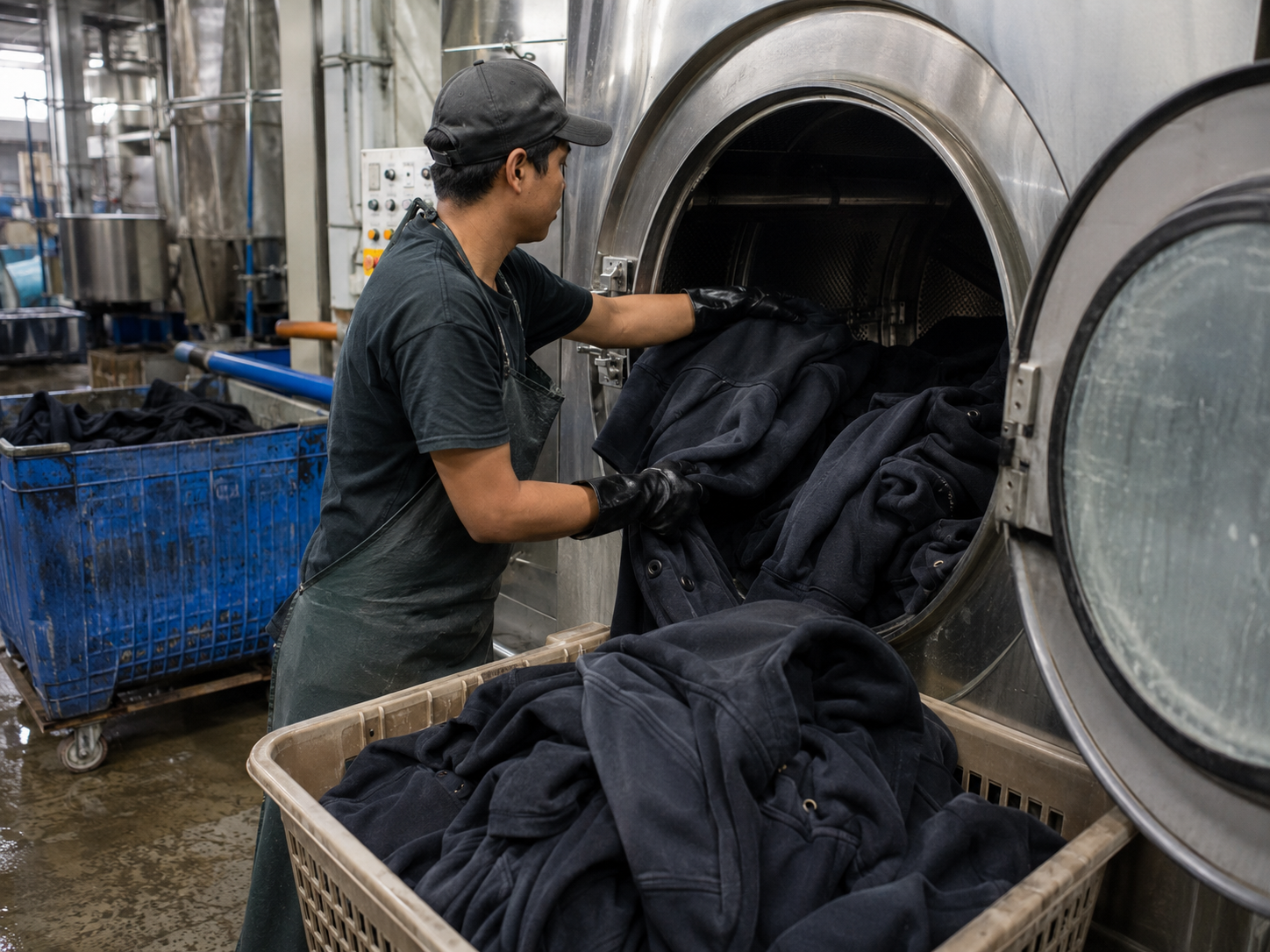
Garment washing exposes the fabric and finished garment to water, movement, temperature, drying, and mechanical action.
These processes can release tension already stored inside the fabric and change the way the knitted structure sits.
From our experience producing custom streetwear, the final hoodie measurements are influenced not only by the sewing pattern.
They are also affected by:
Fabric + Shrinkage + Washing Process + Drying + Garment Construction
That is why washed hoodies should be tested before bulk production rather than assuming the measurements will remain exactly the same after washing.
Table of Contents
- Why Hoodie Measurements Change After Washing
- 1. Fabric Releases Tension During Washing
- 2. Cotton Fibers React to Water and Drying
- 3. Heat Can Increase Dimensional Change
- 4. Knitted Fabric Can Change in Different Directions
- 5. Garment Washing Adds More Variables
- 6. Seams Can Affect the Final Garment Shape
- Why Pre-Shrunk Fabric Can Still Change
- How We Test Hoodie Shrinkage Before Bulk Production
- How Should Brands Approve Washed Hoodie Measurements?
- Frequently Asked Questions
- Final Recommendation
Why Hoodie Measurements Change After Washing
A hoodie is made from fabric that has already passed through several manufacturing processes before it becomes a garment.
Depending on the fabric, these may include:
- Spinning
- Knitting
- Dyeing
- Finishing
- Compacting
- Cutting
- Sewing
- Washing
- Drying
During these stages, the fabric can be stretched, compressed, or held under tension.
When the finished hoodie enters water, part of that tension can be released.
The fabric then moves toward a more relaxed state.
This is why measurements taken:
Before Washing
and
After Washing
may not be exactly the same.
If you want to understand hoodie shrinkage in more detail, see:
Why Do Streetwear Hoodies Shrink?
1. Fabric Releases Tension During Washing
One of the most important causes is fabric relaxation.
Knitted fabric is not completely static.
During knitting, dyeing, finishing, spreading, and cutting, tension can be introduced into the fabric.
Before washing, the garment may still contain some of this tension.
Once the hoodie is exposed to water and movement, the knitted loops have an opportunity to relax.
As the fabric relaxes, its dimensions may change.
For example:
Before Washing
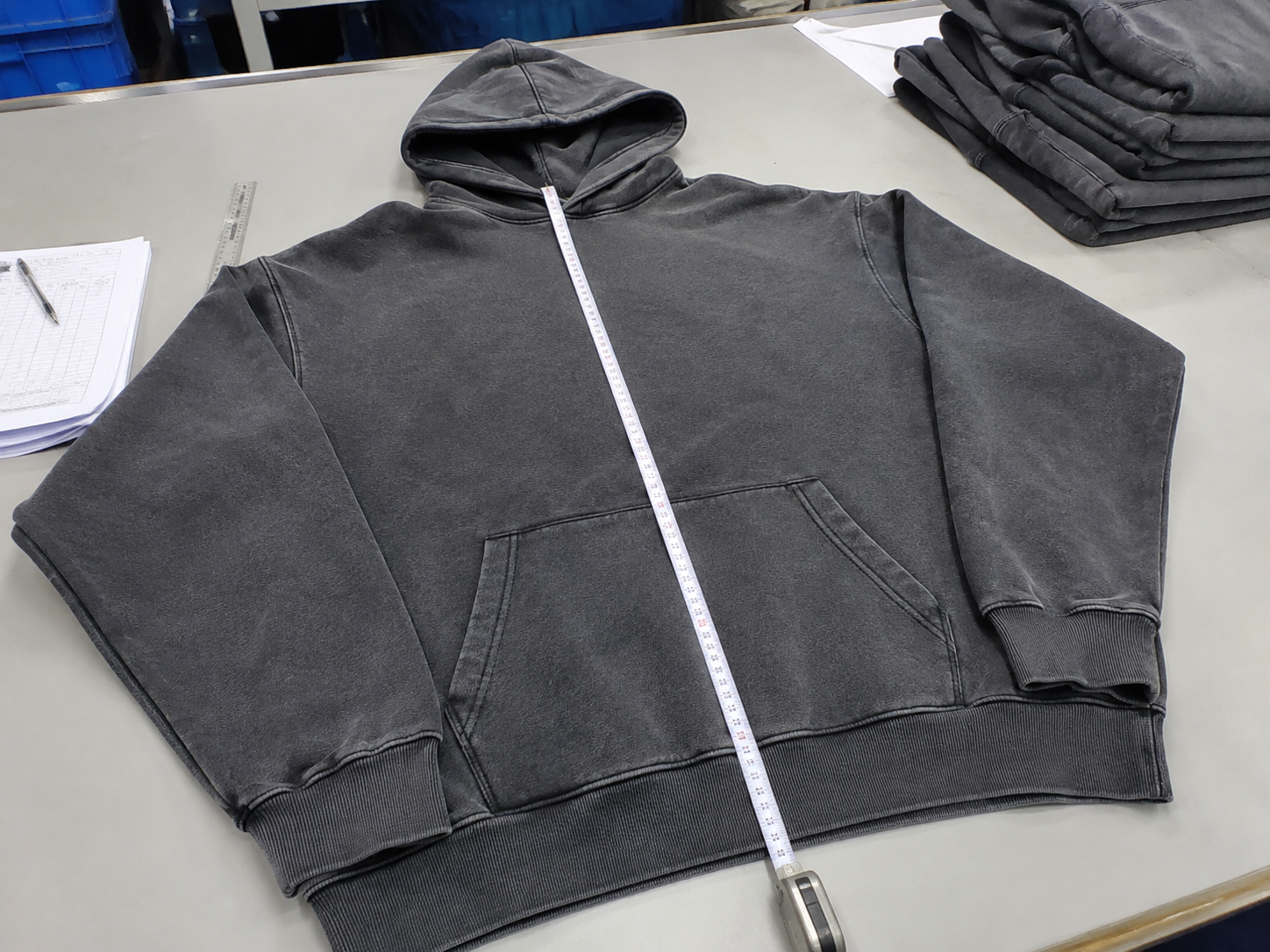
Body Length: 72 cm
After Washing
Body Length: slightly shorter
This does not automatically mean the sewing pattern changed.
The fabric itself may have changed dimensions.
That is why we normally want to understand the shrinkage behavior of a fabric before finalizing the production pattern.
For more information about selecting and testing streetwear fabrics, see:
How to Source Streetwear Fabrics
2. Cotton Fibers React to Water and Drying
Cotton is widely used for heavyweight streetwear hoodies because it provides a natural hand feel and works well with fleece and French terry constructions.
However, cotton-based fabrics can change dimensions during laundering.
Water enters the textile structure during washing.
The fabric then goes through agitation and drying.
During this process, the yarns and knitted loops can rearrange and the fabric can relax from stresses introduced during manufacturing.
This can change:
- Body length
- Chest width
- Sleeve length
- Shoulder width
- Hood dimensions
The amount of dimensional change depends on the actual fabric and finishing process.
That is why it is better to test a specific fabric rather than assume that all cotton hoodies will behave the same way.
AATCC publishes standardized methods specifically for evaluating dimensional changes after laundering.
External reference:
AATCC TM135 – Dimensional Changes of Fabrics After Home Laundering
For finished garments, AATCC also provides:
AATCC TM150 – Dimensional Changes of Garments After Home Laundering
3. Heat Can Increase Dimensional Change
Washing is only part of the process.
Drying conditions are also important.
A hoodie that is:
Cold Washed + Air Dried
may behave differently from the same hoodie that is:
Washed + High-Heat Tumble Dried
Heat and mechanical movement during drying can influence how the fabric relaxes.
This is why shrinkage testing should not only specify:
"Wash the hoodie."
The test conditions should also define how the garment is dried.
For production testing, the washing and drying method should represent the expected care method or the agreed testing standard.
AATCC TM150 includes controlled laundering procedures specifically so dimensional change can be evaluated under repeatable conditions.
4. Knitted Fabric Can Change in Different Directions
Fabric does not always shrink equally in every direction.
A hoodie fabric may change more in:
Length
than in:
Width
or the opposite can happen.
This is related to factors such as:
- Knit construction
- Yarn
- Fabric finishing
- Mechanical tension
- Compacting
- Washing process
For example, a hoodie might become slightly shorter while the chest changes very little.
Another fabric may show more width change.
This is why a simple statement such as:
"The fabric shrinks 5%."
is not always detailed enough.
It is more useful to understand dimensional change in different directions.
For example:
| Direction | Before Wash | After Wash | Result |
|---|---|---|---|
| Length | Measured | Measured | Change calculated |
| Width | Measured | Measured | Change calculated |
The real values should come from testing the actual fabric.
5. Garment Washing Adds More Variables
Streetwear hoodies are often washed intentionally to create a specific appearance.
Common processes include:
- Enzyme wash
- Pigment wash
- Vintage wash
- Acid wash
- Stone wash
- Faded wash
- Garment dye
- Softening treatment
These processes do more than change the color.
They can also affect:
- Fabric relaxation
- Surface texture
- Hand feel
- Garment dimensions
- Seam appearance
For example, a vintage washed hoodie may go through significantly more mechanical processing than an unwashed basic hoodie.
That additional processing can influence the final measurements.
This is why for washed streetwear we prefer to think of the final product as:
Cut Garment → Sew → Wash → Dry → Relax → Measure
rather than judging the final measurements before washing.
The washed garment is the final product.
Therefore, the post-wash measurement is usually the measurement that matters most when approving the finished fit.
6. Seams Can Affect the Final Garment Shape
The fabric is not the only part of the hoodie responding to washing.
A finished hoodie contains many joined components:
- Body panels
- Sleeves
- Rib cuffs
- Waist rib
- Hood
- Neck seam
These components may not all react exactly the same way.
For example, the main body fabric and rib may have different stretch and shrinkage behavior.
If one component changes more than another, it can affect the appearance of the garment after washing.
You may notice:
- Slight seam twisting
- Hem movement
- Sleeve rotation
- Rib pulling
- Side seam distortion
This is another reason the finished garment should be tested, not only a small piece of fabric.
AATCC also maintains specific methods for evaluating laundering-related issues such as garment dimensional change, fabric skew, and seam twist.
External reference:
AATCC – Laundering Test Methods
Why Pre-Shrunk Fabric Can Still Change
A common misunderstanding is:
"If the fabric is pre-shrunk, the hoodie cannot shrink."
That is not necessarily true.
Pre-shrinking or compacting is used to improve dimensional stability.
It does not mean every fabric will remain mathematically unchanged after every wash.
The final result can still be affected by:
- Fiber content
- Knit construction
- Finishing
- Washing temperature
- Drying method
- Garment washing
- Fabric batch
- Garment construction
A better question for a manufacturer is not:
"Will this fabric shrink?"
A better question is:
"What dimensional change does this fabric show under the agreed wash test?"
That can be measured.
How We Test Hoodie Shrinkage Before Bulk Production
For a washed hoodie, we prefer testing dimensional change before the entire order moves into production.
A typical development process is:
Bulk Fabric
↓
Fabric Shrinkage Test
↓
Pattern Adjustment if Needed
↓
Sample Garment
↓
Garment Washing
↓
Drying
↓
Garment Relaxation
↓
Measurement Check
↓
Sample Approval
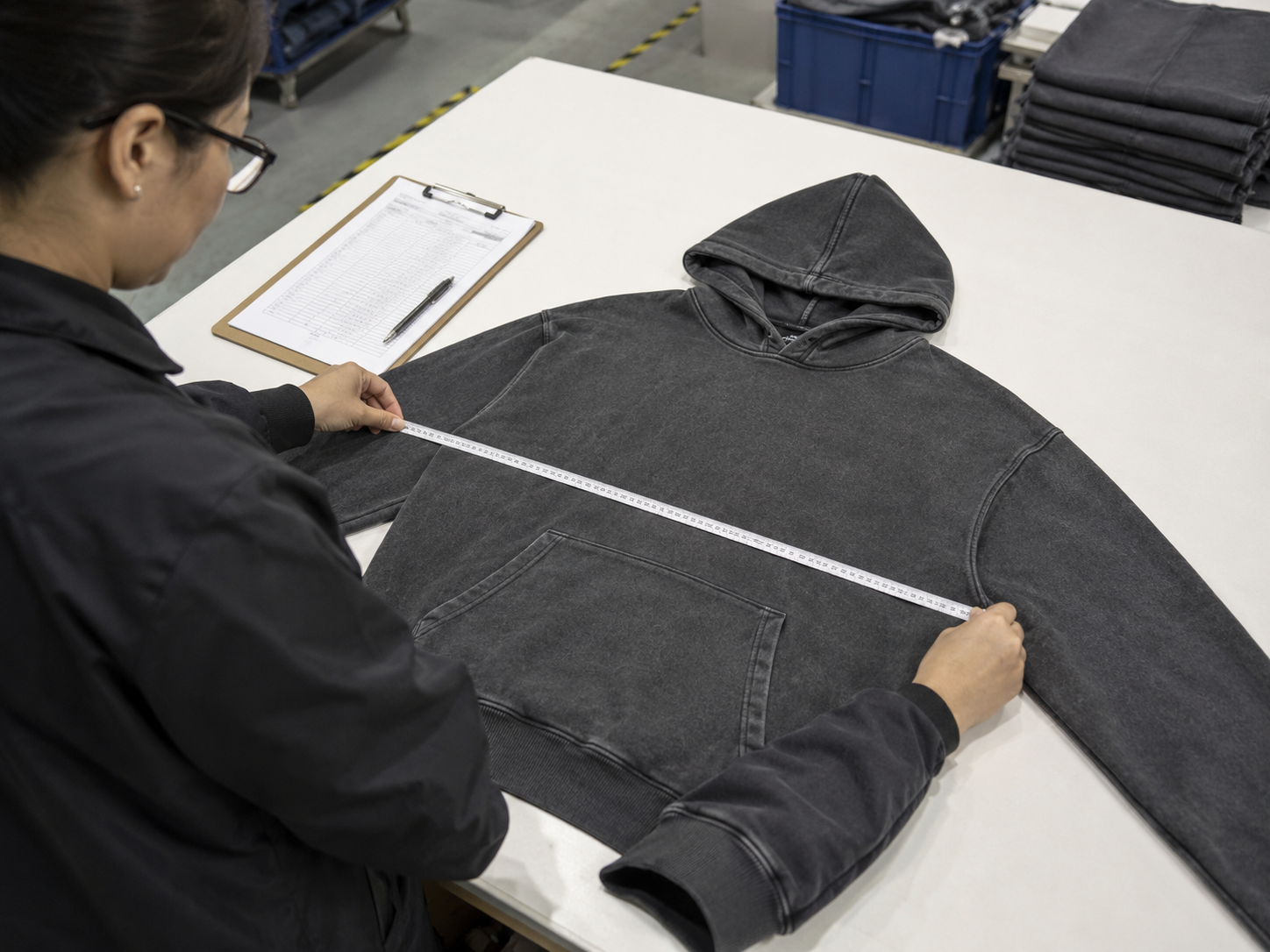
During testing, we may check measurements such as:
- Body length
- Chest width
- Shoulder width
- Sleeve length
- Bottom opening
- Cuff opening
- Hood dimensions
The key is consistency.
Measurements should be taken using the same measurement method before and after washing.
The wash process should also be clearly recorded.
If the sample shows unacceptable dimensional change, it is much easier to adjust the pattern or washing process before hundreds of hoodies have already been made.
You can see how this fits into the complete manufacturing process here:
How Is Custom Streetwear Made?
How Should Brands Approve Washed Hoodie Measurements?
For a garment-washed hoodie, the brand and manufacturer should clearly establish whether the measurement chart refers to:
Before-Wash Measurements
or
After-Wash Measurements
This distinction is very important.
Imagine the target finished body length is:
72 cm after garment washing
If testing shows that the garment becomes shorter during the wash process, the pattern may need to be adjusted before cutting.
In simple terms:
Pattern Measurement ≠ Finished Measurement
The pattern and pre-wash garment may sometimes need extra allowance so the finished washed hoodie reaches the intended measurement.
The exact adjustment should be based on actual testing.
Not guesswork.
For custom streetwear production, we recommend confirming:
- Final fabric
- Wash recipe
- Drying method
- Finished measurement chart
- Measurement tolerances
- Approved washed sample
before bulk production begins.
This is one reason washed garments can require more development time than basic unwashed styles.
You can also read:
Streetwear Production Timeline
Frequently Asked Questions
Why does my hoodie become shorter after washing?
One possible reason is fabric relaxation.
Washing and drying can release tension in the knitted fabric, causing its dimensions to change.
Does a 100% cotton hoodie always shrink?
Cotton hoodies can show dimensional change, but the amount depends on the yarn, knit structure, finishing, compacting, washing conditions, and drying method.
The actual fabric should be tested.
Does heavyweight fabric shrink more than lightweight fabric?
Not necessarily.
GSM alone does not determine shrinkage.
Two fabrics with the same GSM can behave differently because their yarn, knitting, finishing, and construction are different.
Can a factory compensate for hoodie shrinkage?
Yes, when the shrinkage behavior is known and reasonably consistent.
The pattern may be adjusted so the finished washed garment is closer to the intended measurements.
The adjustment should be based on testing.
Should hoodie measurements be checked before or after garment washing?
For a garment-washed product, the final post-wash measurements are particularly important because they represent the product the customer will actually receive.
Why does one part of the hoodie shrink more than another?
Different fabric directions and components can respond differently to washing.
The body fabric, rib, hood, and other components may not have identical dimensional stability.
Can garment washing change the fit of an oversized hoodie?
Yes.
Changes in body length, width, sleeve length, or rib dimensions can affect the final silhouette.
That is why washed oversized hoodies should be fit-approved after the intended wash process.
Final Recommendation
If garment washing changes your hoodie measurements, do not look only at the sewing pattern.
Check the entire process:
Fabric + Shrinkage + Knit Structure + Washing + Drying + Construction + Measurement Method
For washed streetwear, the final fit should ideally be developed around the garment after the intended wash process.
From our production experience, the safest approach is:
Test Fabric → Make Sample → Apply Final Wash → Measure → Adjust Pattern → Approve → Bulk Production
This gives the brand and manufacturer a real production standard instead of guessing how the hoodie will behave after washing.
If you are developing custom oversized hoodies, vintage washed hoodies, pigment washed sweatshirts, or other washed streetwear, Fuki Apparel can help with fabric sourcing, sampling, garment washing, shrinkage testing, fit development, and bulk production.