
Puff print is one of the most popular decoration techniques for heavyweight streetwear T-shirts.
It creates a raised, three-dimensional surface that works especially well for bold logos, lettering, and oversized graphics.
But sometimes a puff print looks good when the sample is finished and starts showing small cracks after stretching, folding, or washing.
Does heavyweight fabric cause this?
Not necessarily.
From our production experience, heavyweight cotton itself is usually not the main problem.
Cracking is more often related to the ink deposit, puff additive ratio, curing temperature, artwork design, and the way the ink interacts with the fabric surface.
Table of Contents
- Why Puff Print Can Crack
- 1. The Puff Ink Was Not Fully Cured
- 2. The Ink Layer Is Too Thick
- 3. The Puff Additive Ratio Is Incorrect
- 4. Too Much Heat Can Damage the Puff Effect
- 5. Heavyweight Fabric Changes How the Ink Sits
- 6. The Artwork May Not Be Suitable for Puff Print
- How We Test Puff Print Before Bulk Production
- What Does Good Puff Print Look Like?
- Frequently Asked Questions
- Final Recommendation
Why Puff Print Can Crack
Puff printing is different from normal flat screen printing.
A puff additive is mixed with the printing ink. During curing, heat activates the additive and causes the printed layer to expand.
This creates the raised surface that gives puff print its distinctive streetwear look.
However, the expanded ink layer is thicker than a normal screen print.
If the ink becomes too thick, is not cured correctly, or is used on an unsuitable artwork structure, it may lose flexibility.
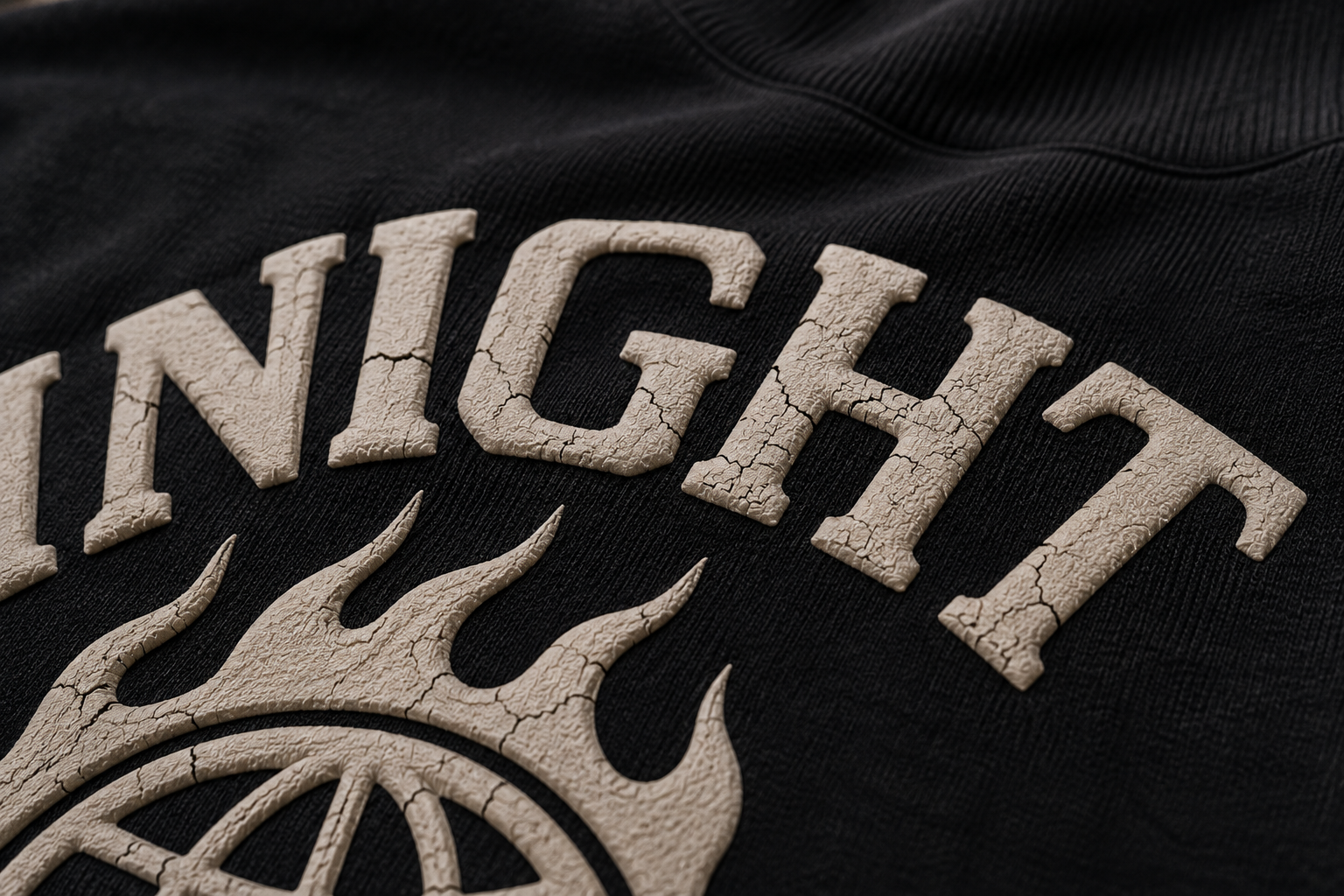
When the garment stretches or bends, small cracks can begin to appear.
If you are deciding between different decoration methods, you can also read:
Embroidery vs Puff Print for Streetwear
1. The Puff Ink Was Not Fully Cured
One of the first things we check when puff print cracks is curing.
The surface of the print can sometimes feel dry even when the deeper part of the ink layer has not fully cured.
This is especially important with puff printing because the ink deposit is normally thicker than standard screen printing.
An undercured puff print may look fine immediately after production.
Problems often appear later after:
- Washing
- Stretching
- Folding
- Wearing
- Repeated friction
The print may begin to:
- Crack
- Split
- Peel
- Lose adhesion
- Break around the edges
The curing temperature and dryer time should follow the requirements of the specific ink system being used.
External reference:
ScreenPrinting.com – Plastisol Ink Curing Guide
2. The Ink Layer Is Too Thick
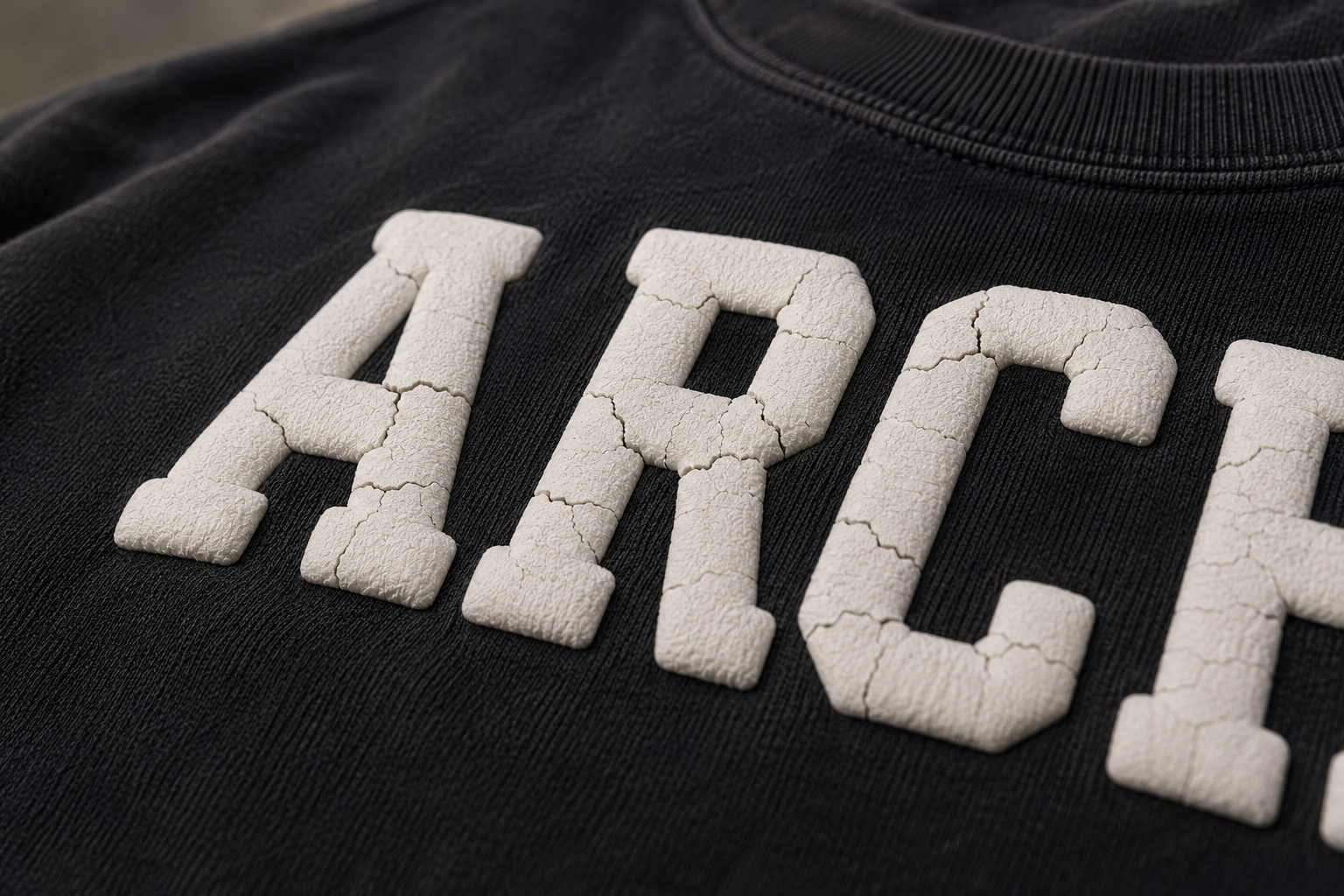
Puff print needs enough ink to create a raised effect.
But more ink does not automatically create a better print.
This is a common issue when brands ask for a very high puff effect.
For example:
Normal Puff Height
Enough ink to create dimension while maintaining flexibility.
Extremely High Puff
More ink and greater expansion, but potentially more stress when the garment stretches.
A very thick puff layer behaves differently from the cotton fabric underneath it.
The T-shirt remains flexible while the thick printed area becomes more rigid.
When the garment bends or stretches repeatedly, cracks can develop in the printed surface.
Ink thickness can be affected by:
- Mesh count
- Stencil thickness
- Number of print passes
- Squeegee pressure
- Ink viscosity
- Puff additive level
The goal should not simply be:
Maximum Puff Height
A better production target is:
Good Puff Height + Clean Surface + Flexibility + Wash Durability
3. The Puff Additive Ratio Is Incorrect
Puff additive controls how much the ink expands during curing.
The amount should normally be measured rather than estimated by eye.
If too little puff additive is used, the print may not rise enough.
If too much is used, the expanded ink structure can become unstable and may affect:
- Puff height
- Surface texture
- Flexibility
- Color
- Wash durability
For bulk production, consistency is especially important.
If different ink batches are mixed using different ratios, one batch may have a higher puff effect than another.
That is why a better production method is:
Ink Weight + Additive Weight + Controlled Mixing
instead of adding puff additive based only on appearance.
Technical reference:
Avient – NPT Puff Additive Technical Data
4. Too Much Heat Can Damage the Puff Effect
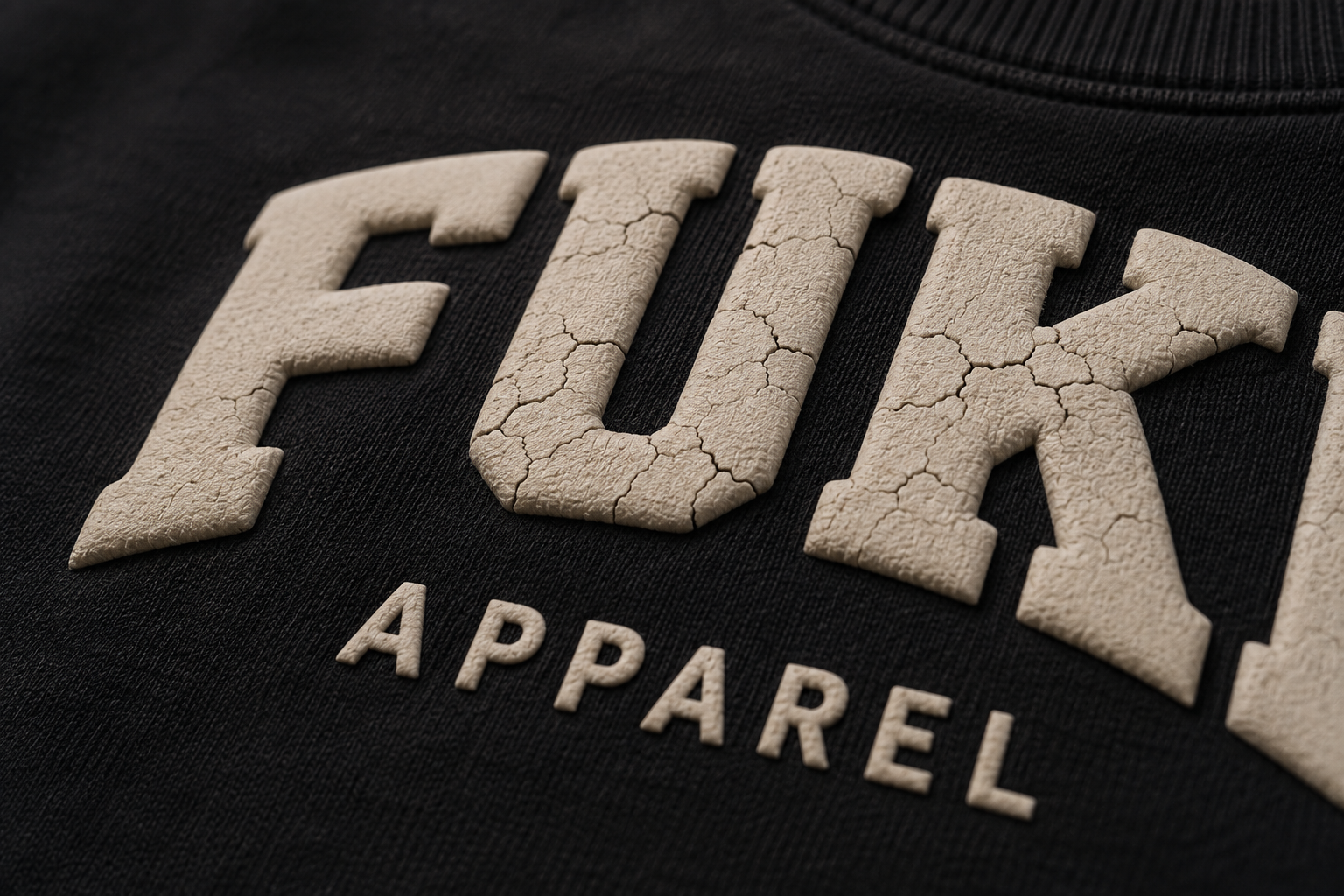
Low curing temperature can cause undercuring.
But excessive heat can also create problems.
Puff ink expands when it reaches the required temperature.
Once the expansion reaches its intended level, additional heat does not necessarily improve the print.
Depending on the ink system, excessive temperature may cause the puff structure to become unstable or begin to collapse.
This can change:
- Puff height
- Surface texture
- Flexibility
- Overall appearance
This is why curing is a balance between:
Temperature + Dryer Speed + Ink Thickness + Fabric
Using the same dryer settings for every fabric and every puff design is not always the best approach.
A thick puff graphic may require different testing from a small chest logo.
5. Heavyweight Fabric Changes How the Ink Sits
Heavyweight cotton is widely used for modern streetwear.
Many oversized T-shirts use fabrics around 220–320 GSM because they provide a more structured and premium feel.
You can learn more about fabric selection here:
Best Fabrics for Oversized Streetwear
However, heavyweight jersey can have a more visible knitted surface than smoother lightweight fabrics.
That surface can influence how the ink sits on the garment.
If the fabric surface is uneven, the ink deposit may also become slightly uneven.
After the puff expands, these differences can become more visible.
That is why we normally look at:
- Fabric GSM
- Knit structure
- Surface smoothness
- Fabric finishing
- Mesh count
- Ink deposit
together.
The solution is not simply:
"Heavyweight fabric needs more ink."
Sometimes adjusting the screen mesh, stencil, printing pressure, or number of passes produces a better result than simply adding more ink.
6. The Artwork May Not Be Suitable for Puff Print
Not every graphic should be converted entirely into puff print.
Puff ink expands during curing.
This means the final printed area becomes larger and thicker than the original wet ink layer.
Some artwork structures are more difficult to control.
These include:
- Very thin lines
- Tiny lettering
- Extremely small gaps
- Large solid blocks
- Dense overlapping details
- Very large full-back puff areas
For example, a small bold chest logo is usually easier to control than a large solid puff graphic covering most of the back.
Large puff areas also have more surface area that must bend together with the T-shirt.
For some designs, we may recommend:
Flat Screen Print + Selected Puff Details
instead of using puff ink across the entire artwork.
This can create stronger visual contrast while improving flexibility.
How We Test Puff Print Before Bulk Production
For a new puff print, we prefer testing it on the actual production fabric before bulk production.
A typical process is:
Artwork
↓
Screen Preparation
↓
Puff Ink Mixing
↓
Test Printing
↓
Curing
↓
Check Puff Height
↓
Stretch Test
↓
Wash Test
↓
Sample Approval
During testing, we normally check:
- Puff height
- Surface texture
- Artwork edges
- Small details
- Cracking after stretching
- Ink adhesion
- Fabric distortion
- Wash durability
- Color consistency
If the print cracks during testing, increasing the amount of puff is usually not the first solution.
Instead, we may adjust:
- Ink deposit
- Puff additive ratio
- Screen mesh
- Artwork
- Curing temperature
- Dryer speed
- Number of print passes
This is easier to correct during sampling than after hundreds of T-shirts have already been printed.
You can also see more decoration options here:
Custom Streetwear Printing Services
What Does Good Puff Print Look Like?
A good puff print should be raised without becoming excessively thick or unstable.
For streetwear production, we normally look for:
| Check Point | Good Result |
|---|---|
| Puff Height | Raised and consistent |
| Surface | Even without major collapse |
| Artwork Edge | Clean and recognizable |
| Small Details | Still visible |
| Flexibility | Does not crack easily |
| Adhesion | Firmly attached to fabric |
| Washing | No obvious peeling or splitting |
| Bulk Production | Similar effect across garments |
Puff print is a special-effect printing technique.
This means very small differences in texture can occur between garments.
The important point is whether the final result remains within the approved visual and quality standard.
Frequently Asked Questions
Does heavyweight cotton cause puff print to crack?
No.
Heavyweight cotton itself is usually not the direct cause.
Cracking is more commonly related to curing, ink thickness, puff additive ratio, artwork, and printing conditions.
Can puff print be used on 300 GSM T-shirts?
Yes.
Heavyweight cotton T-shirts can work very well with puff printing when the ink deposit and curing conditions are properly controlled.
Is thicker puff print more durable?
Not necessarily.
An excessively thick puff layer may become less flexible and can be more likely to crack when the garment bends or stretches.
Why does puff print crack after washing?
Undercuring is one possible reason.
The print may appear normal when it leaves the factory but begin to crack if the deeper ink layer was not fully cured.
Ink formulation and excessive print thickness can also affect wash durability.
Can a large back graphic use puff print?
Yes, but large solid puff areas normally require more testing.
For some artwork, using puff only on selected details can provide a better balance between appearance and durability.
Should puff print be wash tested before bulk production?
Yes, especially for new fabrics or new puff-print constructions.
Stretch and wash testing can reveal problems that may not be visible immediately after printing.
Final Recommendation
If puff print cracks on a heavyweight T-shirt, do not immediately assume the fabric GSM is the problem.
Check the complete printing system:
Fabric + Artwork + Ink Deposit + Puff Additive + Screen Mesh + Curing Temperature + Dryer Time
From our production experience, the best puff print is not always the thickest one.
A better target is:
Good Puff Height + Clean Artwork + Consistent Texture + Flexibility + Wash Durability
That is why puff printing should be tested on the actual production fabric before moving into bulk production.
If you are developing heavyweight oversized T-shirts with puff print, screen printing, embroidery, or other custom decorations, Fuki Apparel can help with fabric sourcing, print testing, sampling, and bulk production.