
A vintage-washed T-shirt should not simply look "old."
A good vintage wash changes several things at the same time:
- Color depth
- Surface appearance
- Fabric softness
- Drape
- Seam character
- Overall hand feel
That is why the same T-shirt can feel very different before and after garment washing.
For streetwear brands, vintage washing is commonly used to create:
- Faded black
- Washed gray
- Muted earth tones
- Soft worn-in surfaces
- Slightly aged seams and edges
But "vintage wash" is not one single standardized process.
The final effect depends on:
Fabric + Dye Method + Wash Chemistry + Mechanical Action + Temperature + Drying
From our production experience, the most important step is testing the wash on the actual production garment before bulk production.
Table of Contents
- What Does Vintage Wash Actually Mean?
- 1. Vintage Washing Reduces Color Intensity
- 2. The Surface Becomes Less Uniform
- 3. Washing Can Make Cotton Feel Softer
- 4. Fabric Drape Can Change After Washing
- 5. Seams and Edges Often Fade Differently
- 6. Black T-Shirts Can Shift Toward Different Washed Tones
- 7. Vintage Washing Can Change Garment Measurements
- 8. Not Every Fabric Produces the Same Vintage Effect
- How We Develop a Vintage Wash Before Bulk Production
- Frequently Asked Questions
- Final Recommendation
What Does Vintage Wash Actually Mean?
"Vintage wash" is usually a commercial description of the final appearance rather than one single technical washing method.
Depending on the desired result, a factory may use combinations of:
- Garment washing
- Enzyme treatment
- Pigment-dyed garments
- Mechanical abrasion
- Softening
- Controlled fading
- Stone or stone-effect processes
The purpose is generally to create a garment that looks and feels less new.
A fresh T-shirt may have:
- Strong uniform color
- Cleaner surface
- Firmer hand feel
After vintage washing, the same garment may become:
- More faded
- Less uniform
- Softer
- More relaxed
The exact process should always be confirmed with the factory because two suppliers may use the term vintage wash for different production methods.
1. Vintage Washing Reduces Color Intensity
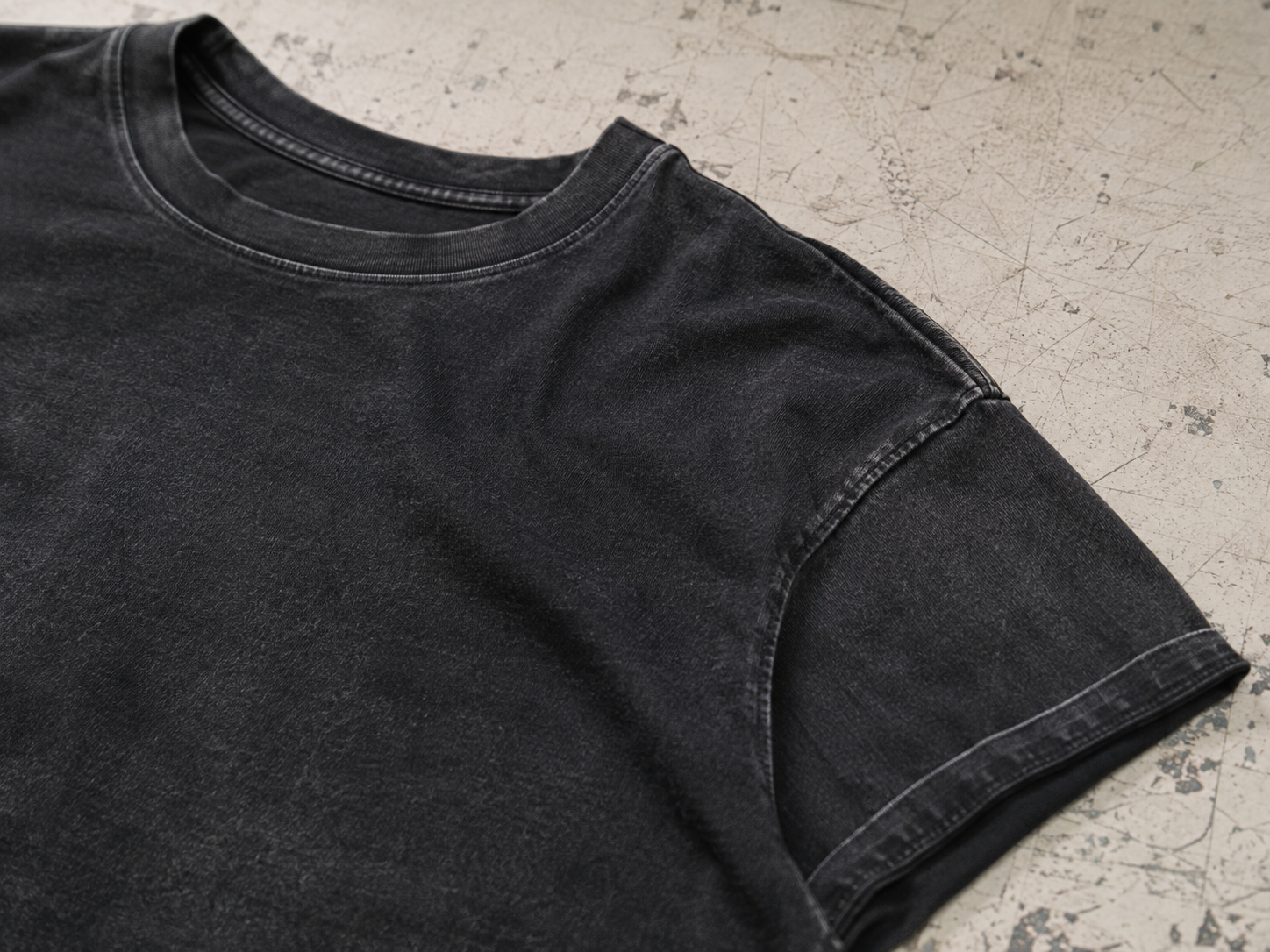
Color change is usually the most visible result.
A fresh black T-shirt may look:
Deep Black
After washing, it can become:
Washed Black
Charcoal
or:
Faded Gray-Black
depending on the original dye and wash process.
The wash can remove or visually reduce color from the surface of the fabric.
This creates the aged appearance commonly seen in streetwear.
However, the amount of fading depends heavily on:
- Dye type
- Fiber content
- Wash time
- Wash chemistry
- Mechanical action
- Temperature
This means a factory cannot simply say:
"Wash it for longer."
and guarantee the exact result.
The color needs to be developed and approved from a physical sample.
2. The Surface Becomes Less Uniform
A new T-shirt often has a very even surface.
Vintage washing can intentionally reduce that uniform appearance.
The garment may develop:
- Slight high-and-low color variation
- Softer edges
- More visible fabric texture
- Natural-looking surface variation
This is one of the reasons vintage-washed garments often appear more premium than simply using a lighter solid color.
A washed gray T-shirt is not necessarily the same as:
A T-shirt dyed gray from the beginning.
The washed garment often has more variation across:
- Seams
- Edges
- Fold areas
- Raised surfaces
That unevenness is part of the vintage character.
3. Washing Can Make Cotton Feel Softer
Vintage washing does not only change color.
It can also change the hand feel.
For cotton T-shirts, selected washing processes may help create a softer and more broken-in surface.
Enzyme treatments are commonly used in cotton processing because cellulase enzymes can act on surface cellulose fibers and modify the fabric surface.
External reference:
CottonWorks – Cotton Finishing and Garment Processing
After an appropriate washing process, a heavyweight cotton T-shirt may feel:
- Softer
- Less rigid
- More relaxed
- More comfortable against the skin
However:
More washing does not always mean softer is better.
Excessive treatment can potentially affect:
- Fabric strength
- Surface appearance
- Color consistency
- Garment dimensions
The process needs to be controlled.
4. Fabric Drape Can Change After Washing
A heavyweight T-shirt can feel relatively firm immediately after sewing.
After washing and drying, the textile structure may relax.
This can affect the way the garment hangs.
Before washing, the T-shirt may look:
- Very structured
- Slightly rigid
After washing, it may become:
- More relaxed
- Softer in movement
- More naturally draped
This matters for oversized streetwear.
A 260 GSM oversized T-shirt should still maintain enough structure to hold:
- Dropped shoulders
- Wide sleeves
- Boxy proportions
while avoiding an unnecessarily stiff feel.
The correct wash should soften the garment without destroying the intended silhouette.
5. Seams and Edges Often Fade Differently
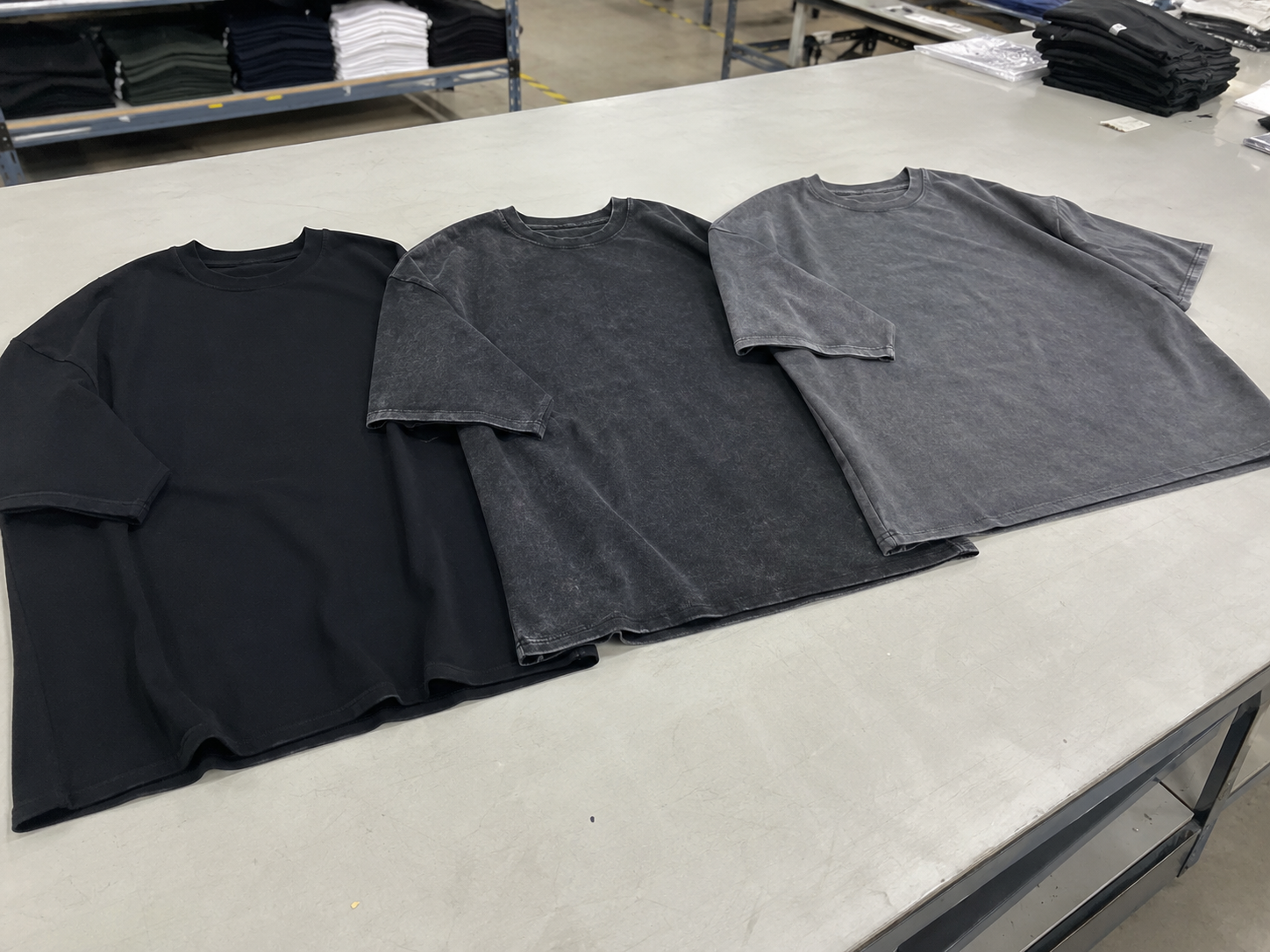
One of the most recognizable vintage-wash effects appears around:
- Neck rib
- Sleeve hems
- Bottom hem
- Shoulder seams
- Side seams
Why?
These areas have:
- Additional fabric thickness
- Raised edges
- Stitching
- More mechanical contact during washing
As the garment moves inside the washing machine, these areas can react differently from flat fabric surfaces.
This creates subtle contrast between:
Main Body
and:
Seams / Edges
For many streetwear brands, this is desirable because it creates a naturally worn appearance.
However, uncontrolled fading can also look inconsistent.
That is why the sample needs to establish how much seam contrast is acceptable.
6. Black T-Shirts Can Shift Toward Different Washed Tones
Not every washed black looks the same.
Depending on the original dye and wash process, black can develop undertones such as:
- Neutral gray
- Blue-gray
- Warm charcoal
- Slight brown tone
This is why two washed black fabrics may look different even under the same lighting.
For a brand, simply requesting:
"Vintage black"
is usually not precise enough.
It is better to provide:
- Physical reference garment
- Approved wash sample
- Color target
- Desired fading level
A physical approved sample is especially useful because photography can make washed black appear different depending on:
- Lighting
- Camera
- Screen
- White balance
For more information about black fabric color differences:
Why Can Two Black Fabrics Look Different Under the Same Light?
7. Vintage Washing Can Change Garment Measurements
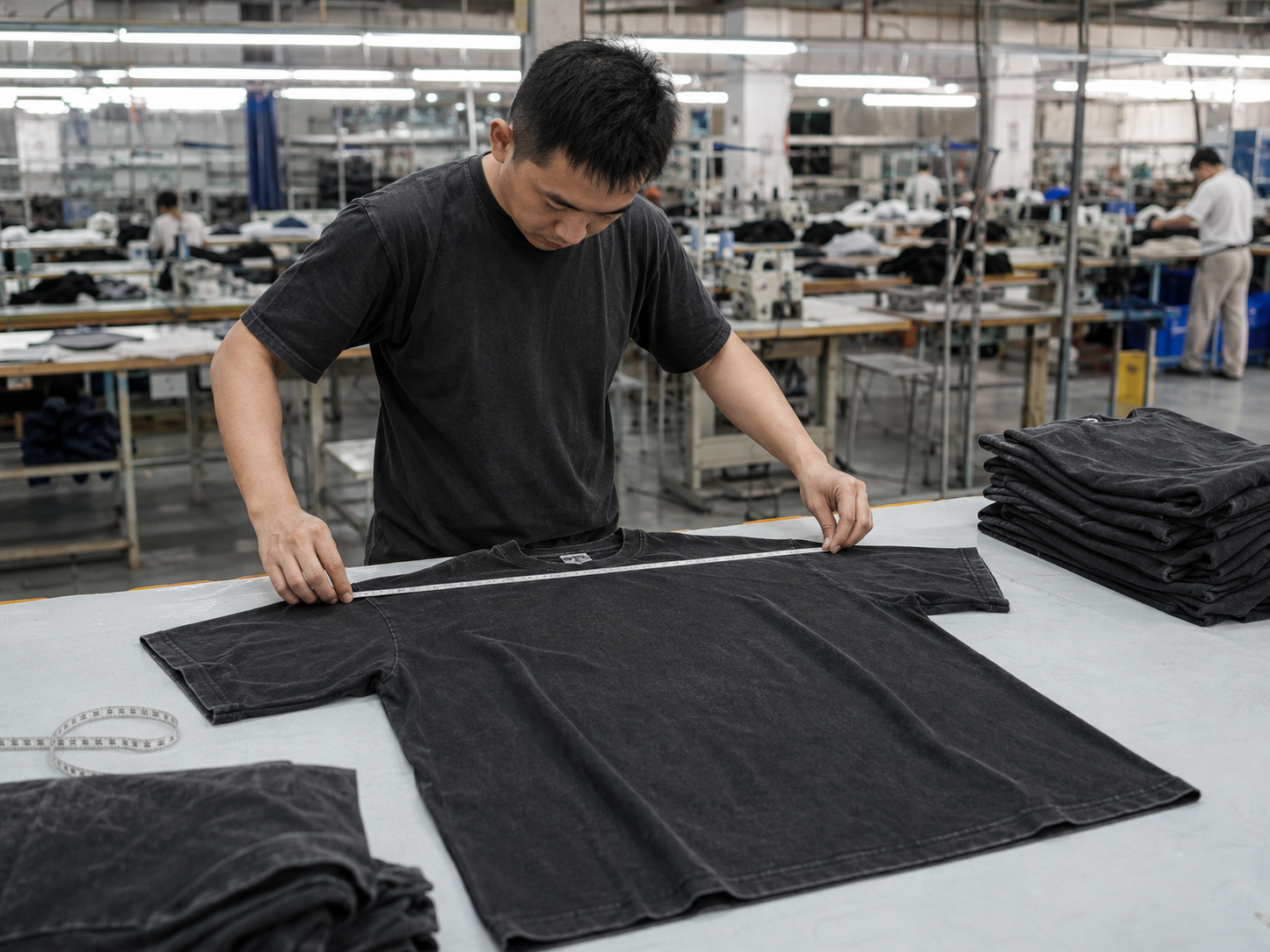
This is one of the most important production issues.
Vintage washing can affect:
- Body length
- Chest width
- Sleeve length
- Shoulder width
- Overall shape
The reason is that washing exposes the fabric to:
- Water
- Mechanical movement
- Temperature
- Drying
The textile structure may relax or shrink during this process.
This means a garment measuring correctly before washing may not measure exactly the same afterward.
For washed garments, we prefer evaluating:
Post-Wash Measurements
rather than judging only the sewn garment before washing.
You can read more here:
Why Does Fabric Shrink After Garment Washing?
8. Not Every Fabric Produces the Same Vintage Effect
The same washing process can produce very different results on different fabrics.
Important variables include:
Fiber Content
100% cotton usually reacts differently from cotton-polyester blends.
Fabric Weight
A 180 GSM T-shirt may respond differently from a 300 GSM heavyweight jersey.
Knit Density
A dense fabric can create a different surface effect from a looser knit.
Dye Method
The original coloration method has a major influence on how the garment fades.
Fabric Finishing
Previous softening, compacting, or other finishing processes can also affect the result.
This means the factory should not assume:
"We used this wash on another T-shirt, so it will look exactly the same."
A new fabric should be tested again.
How We Develop a Vintage Wash Before Bulk Production
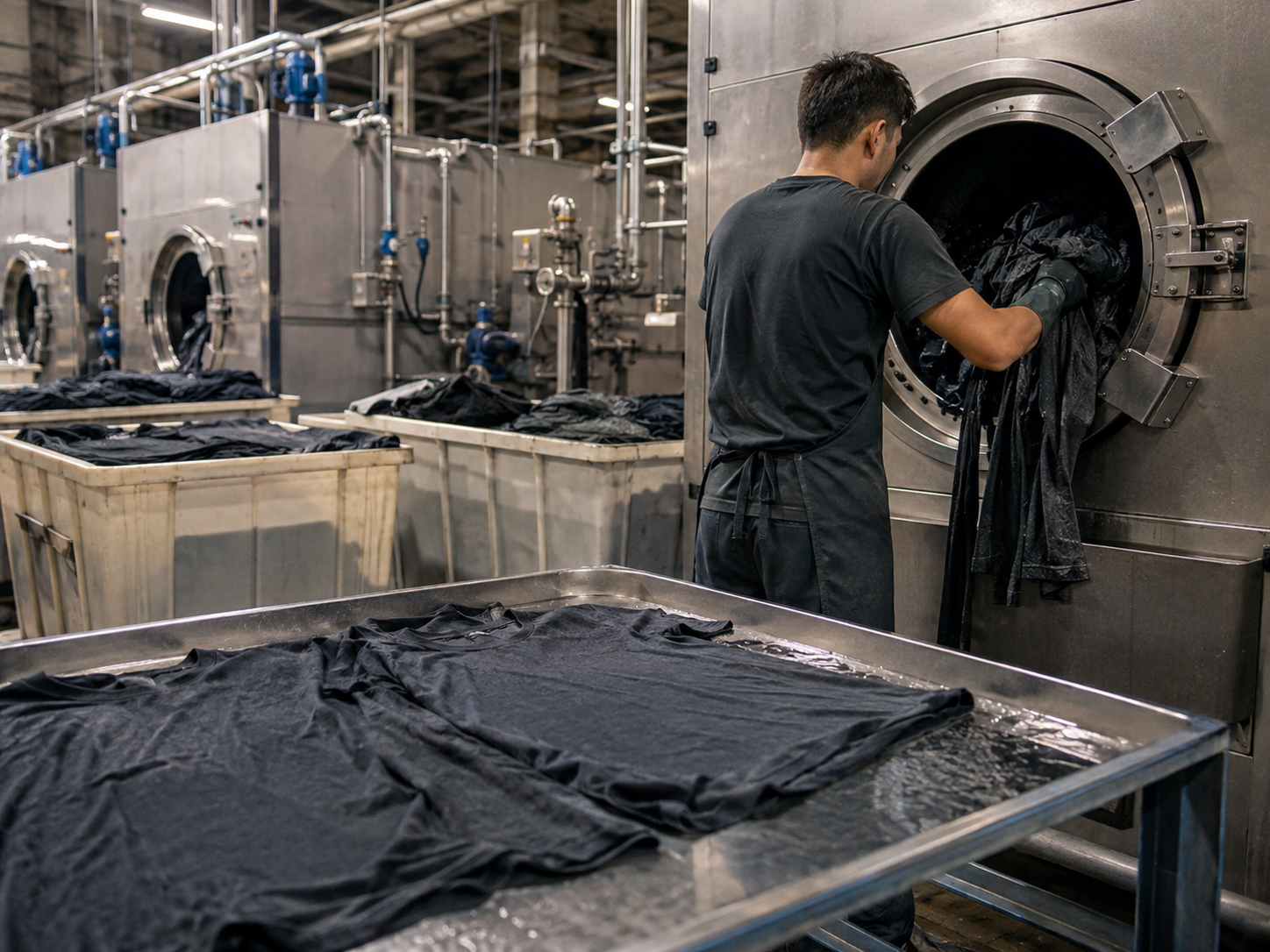
For a custom vintage-washed T-shirt, the safest approach is to develop the wash using the actual production fabric.
A typical process is:
Choose Fabric
↓
Make Garment Sample
↓
Confirm Base Color
↓
Apply Wash Test
↓
Dry and Relax
↓
Check Color
↓
Check Hand Feel
↓
Measure Garment
↓
Adjust Wash if Required
↓
Approve Reference Sample
↓
Bulk Production
During wash development, we normally review:
- Overall fading
- Seam contrast
- Surface appearance
- Hand feel
- Shrinkage
- Measurements
- Fabric damage
- Color consistency
The approved washed garment should then become the visual standard for bulk production.
Because vintage effects contain natural variation, bulk garments may not look mathematically identical.
But they should remain within an agreed appearance range.
Frequently Asked Questions
Does vintage wash always make a T-shirt softer?
Often it can soften the garment, but the result depends on the fabric and actual washing process.
Is vintage wash the same as acid wash?
No.
Vintage wash is a broad appearance description, while acid wash refers to a more specific type of washed effect.
Does vintage wash cause shrinkage?
It can.
Water, mechanical action, temperature, and drying can change garment dimensions.
Why does black turn gray after vintage washing?
The washing process can reduce the visual depth of the surface color, creating a faded charcoal or gray-black appearance.
Can a 300 GSM T-shirt be vintage washed?
Yes.
Heavyweight cotton T-shirts are commonly used for washed streetwear, but the fabric and wash should be tested before bulk production.
Will every vintage-washed T-shirt look exactly the same?
Not perfectly.
Garment washing can produce natural variation, but the factory should control the result within an approved range.
Can vintage wash weaken fabric?
Over-processing can affect surface fibers and potentially reduce fabric performance.
That is why the wash needs proper testing and control.
Should the sample be approved before or after washing?
For a washed product, the final approval sample should be evaluated after the intended washing and drying process.
Final Recommendation
Vintage washing changes much more than color.
It can affect:
Color + Surface + Softness + Drape + Measurements + Overall Character
A successful vintage T-shirt should not simply look faded.
It should feel intentionally developed.
The safest production workflow is:
Final Fabric → Garment Sample → Wash Test → Dry → Measure → Review Color & Hand Feel → Approve → Bulk Production
For streetwear brands, the approved washed sample should become the reference standard for production.
If you are developing vintage-washed T-shirts, washed hoodies, faded streetwear, or heavyweight garments, Fuki Apparel can help with fabric sourcing, wash development, sample testing, measurement control, and bulk production.