
Heavyweight hoodies are often associated with premium streetwear.
A brand may ask for:
400 GSM
450 GSM
or even:
500 GSM fleece
because they want a thick, structured, high-quality hoodie.
But after receiving the sample, there is sometimes another problem:
"The fabric feels too stiff."
The hoodie may stand up nicely, but it does not drape naturally.
The sleeves feel rigid.
The hood feels heavy.
Or the garment feels more like armor than a comfortable sweatshirt.
Why does this happen?
Because GSM only tells you the weight of the fabric per square meter.
It does not tell you how soft, flexible, dense, brushed, compact, or comfortable that fabric will feel.
From our experience developing heavyweight streetwear, hoodie hand feel depends on the complete fabric construction:
GSM + Yarn + Knit Density + Fiber Content + Fleece Structure + Brushing + Finishing + Washing
Table of Contents
- Why Heavyweight Does Not Always Mean Soft
- 1. High GSM Can Come From a Very Dense Fabric
- 2. Yarn Construction Changes the Hand Feel
- 3. Fleece and French Terry Feel Very Different
- 4. Fiber Composition Affects Softness and Flexibility
- 5. Brushing Has a Major Effect on Hoodie Softness
- 6. Finishing Can Make Fabric Softer or Stiffer
- 7. Garment Washing Can Change the Final Hand Feel
- 8. Hood and Rib Construction Can Make the Whole Hoodie Feel Heavy
- Why GSM Alone Is Not Enough When Choosing Hoodie Fabric
- How We Evaluate Heavyweight Hoodie Fabric Before Production
- Frequently Asked Questions
- Final Recommendation
Why Heavyweight Does Not Always Mean Soft
One of the biggest misunderstandings in custom streetwear production is:
"Higher GSM means better fabric."
Not necessarily.
GSM stands for grams per square meter.
It describes fabric weight.
For example:
- 280 GSM
- 350 GSM
- 400 GSM
- 500 GSM
tell you how heavy the fabric is.
But GSM does not directly tell you:
- Softness
- Drape
- Flexibility
- Surface texture
- Thickness
- Stretch
- Warmth
- Recovery
Two fabrics can both be 400 GSM and feel completely different.
One may feel soft, plush, and relaxed.
The other may feel dense, dry, and rigid.
That is why we normally recommend evaluating an actual fabric swatch rather than selecting hoodie material based only on GSM.
If you are sourcing materials for a new collection, see:
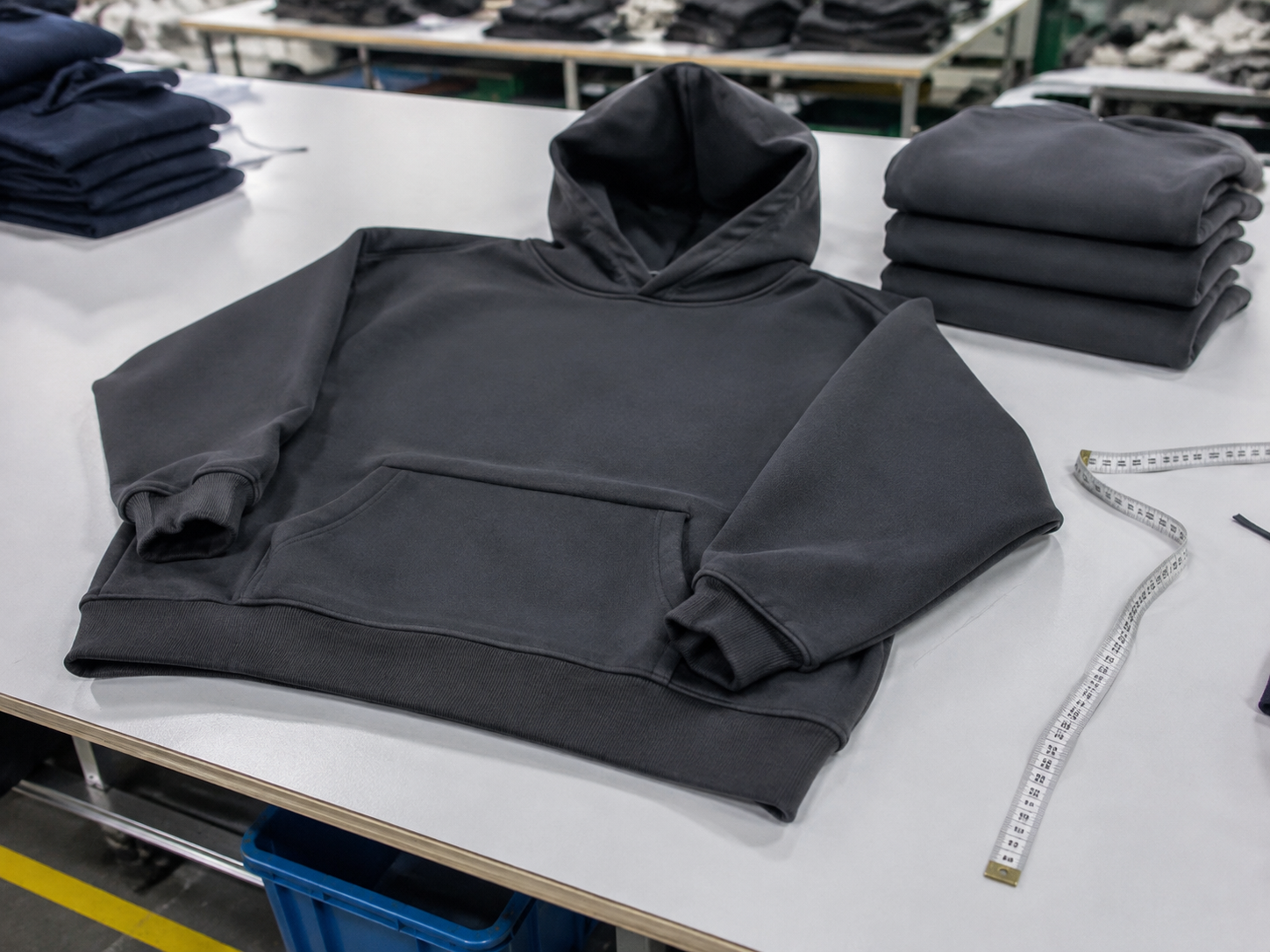
How to Source Streetwear Fabrics
1. High GSM Can Come From a Very Dense Fabric
There are different ways to create a heavyweight fabric.
One method is to use more yarn and create a dense knitted structure.
This can produce a fabric that feels:
- Thick
- Stable
- Structured
- Less stretchy
- Less fluid
That structure can be useful.
For example, an oversized hoodie may need enough body to maintain:
- Dropped shoulders
- A boxy silhouette
- A large hood
- Wide sleeves
But if the fabric becomes too dense, the hoodie may lose too much flexibility.
The garment can start to feel stiff when worn.
This is why we do not only ask:
"What GSM do you want?"
We also look at:
Density + Thickness + Drape + Hand Feel
A structured streetwear hoodie needs some stiffness.
It just should not feel unnecessarily rigid.
2. Yarn Construction Changes the Hand Feel
The yarn used to make the fabric also affects how the hoodie feels.
Important factors can include:
- Yarn count
- Yarn twist
- Spinning method
- Fiber length
- Yarn combination
For example, a more tightly twisted yarn can create a firmer, cleaner fabric surface.
A softer yarn construction may create a more relaxed hand.
This means two factories could both offer:
100% Cotton, 400 GSM Hoodie Fabric
but the fabrics may still feel very different.
The reason is that the specification does not describe everything happening inside the yarn and knitted structure.
For brands that care about hand feel, the physical fabric sample is more useful than the GSM number alone.
3. Fleece and French Terry Feel Very Different
Another major factor is the inside construction of the fabric.
Two common hoodie fabrics are:
French Terry
French terry normally has loops visible on the inside.
It can feel:
- More breathable
- Less fluffy
- Cleaner
- More structured
Brushed Fleece
Fleece is typically brushed on the inside to create a softer, raised surface.
It can feel:
- Softer
- Warmer
- Fluffier
- More insulated
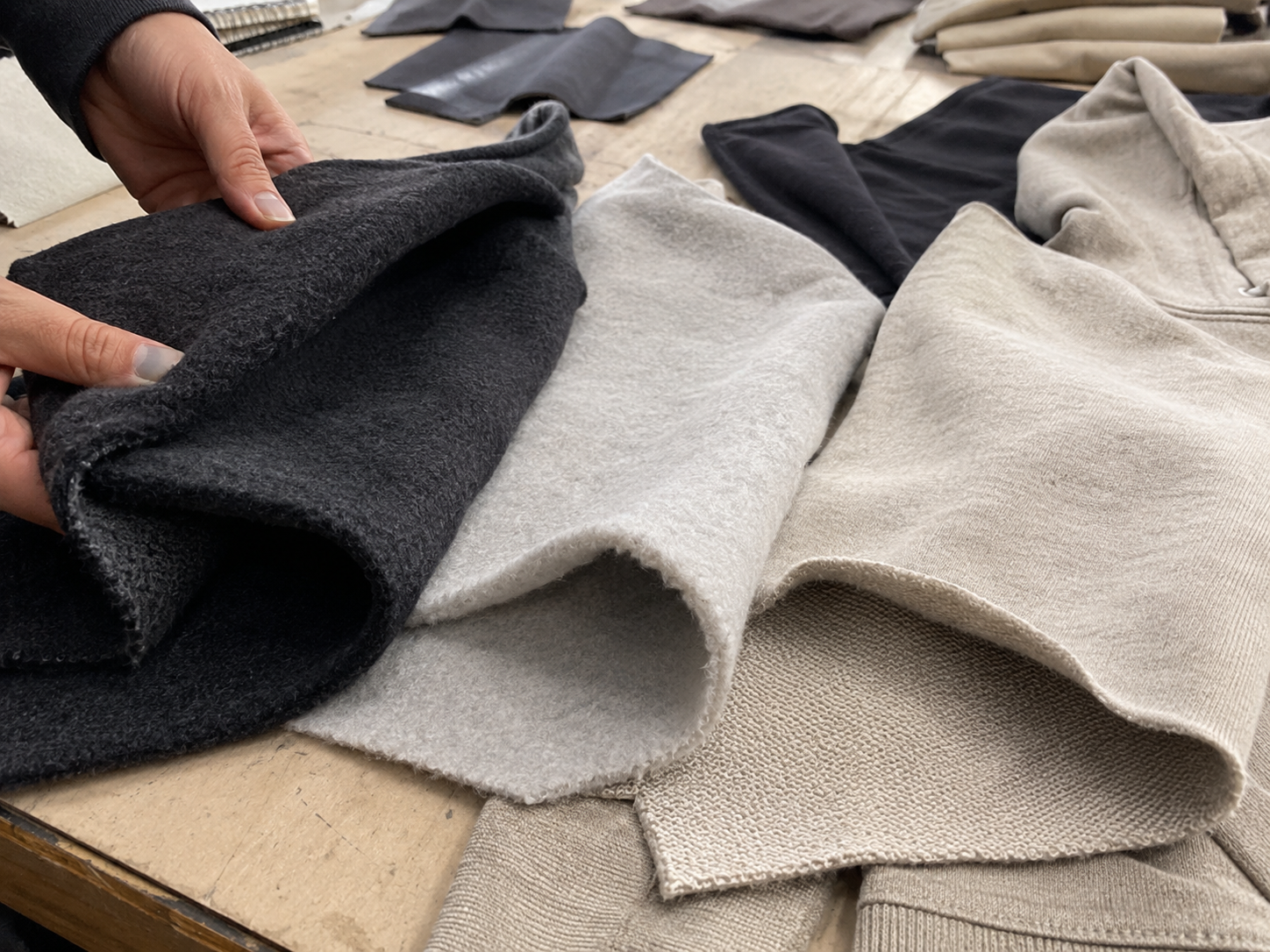
CottonWorks also distinguishes fleece from French terry, describing fleece as more plush and warm while French terry offers a more breathable construction.
External reference:
CottonWorks – Cotton Knit Fabric Basics
This is why two 400 GSM hoodie fabrics can have very different comfort levels.
A dense unbrushed French terry may feel significantly firmer than a well-brushed 400 GSM fleece.
Neither one is automatically better.
They simply create different products.
4. Fiber Composition Affects Softness and Flexibility
Fiber content also changes the hand feel.
Common heavyweight hoodie fabrics include:
- 100% Cotton
- Cotton / Polyester
- Cotton / Recycled Polyester
- Cotton / Spandex blends
100% Cotton
Heavyweight cotton can create a premium natural hand.
But depending on the yarn and finishing, it can also feel relatively firm when new.
Cotton / Polyester
Polyester can change:
- Fabric stability
- Weight
- Recovery
- Surface feel
- Drying behavior
A cotton-polyester fleece can sometimes feel softer or more stable than a similar all-cotton construction.
However, fiber composition alone still does not determine softness.
For example:
100% Cotton ≠ Automatically Soft
and
Cotton / Polyester ≠ Automatically Stiff
The complete fabric construction matters.
5. Brushing Has a Major Effect on Hoodie Softness
For fleece hoodies, brushing is one of the most important stages affecting the final hand feel.
During brushing, the inside surface of the fabric is mechanically raised.
This creates the soft, fuzzy interior commonly associated with fleece sweatshirts.
The amount of brushing can affect:
- Softness
- Loft
- Warmth
- Thickness perception
- Surface appearance
A lightly brushed fleece may still feel relatively firm.
A more developed brushing process can create a softer and fuller interior.
However, more brushing is not always better.
Excessive brushing can potentially affect:
- Fiber shedding
- Surface durability
- Pilling
- Fabric appearance
The goal is to create the intended softness while maintaining acceptable durability.
This is why we prefer evaluating the actual finished fleece rather than judging it before the final finishing process.
6. Finishing Can Make Fabric Softer or Stiffer
Fabric does not leave the knitting machine ready to become a hoodie.
It normally goes through additional finishing processes.
Depending on the fabric, these may include:
- Dyeing
- Washing
- Brushing
- Compacting
- Softening
- Anti-pilling treatment
- Surface finishing
These processes can significantly change the final hand feel.
A fabric that feels slightly harsh before finishing may feel much softer afterward.
The opposite can also happen.
Some performance or durability finishes may create a firmer surface depending on the chemistry and application.
This is why fabric hand is important enough that AATCC has standardized procedures specifically for evaluating textile hand.
External reference:
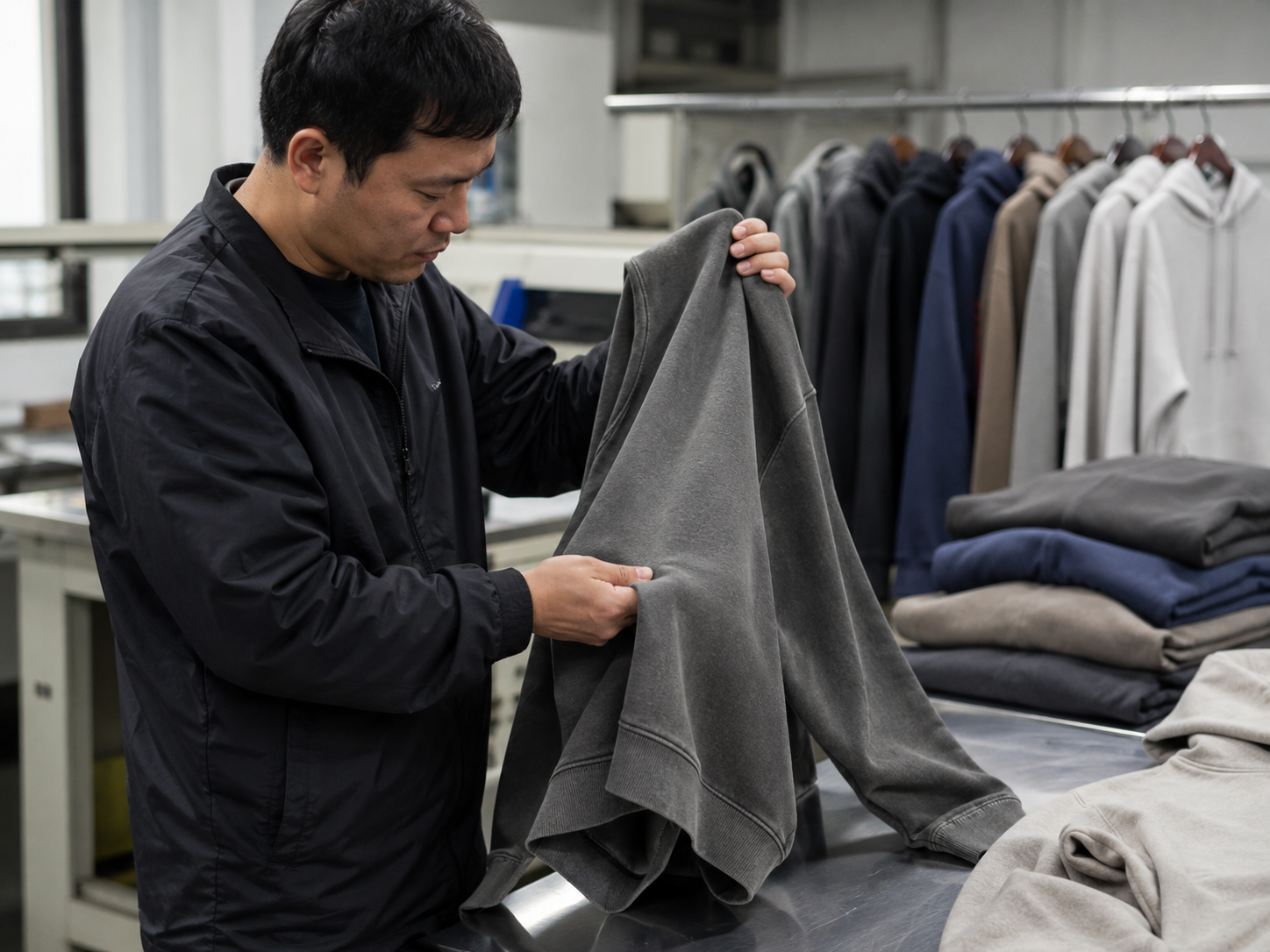
AATCC EP5 – Fabric Hand Evaluation
AATCC also provides instrumental methods for comparing the relative hand of textile materials.
External reference:
AATCC TM202 – Relative Hand Value of Textiles
For clothing brands, the practical lesson is simple:
Do not approve hoodie fabric before the important finishing processes are completed.
7. Garment Washing Can Change the Final Hand Feel
Streetwear hoodies are often washed after sewing.
Common processes include:
- Enzyme wash
- Pigment wash
- Vintage wash
- Garment wash
- Soft wash
- Acid wash
These processes can change much more than color.
They may also affect:
- Surface texture
- Fabric relaxation
- Softness
- Drape
- Measurements
- Vintage appearance
For example, a heavyweight cotton hoodie may feel relatively rigid immediately after sewing.
After an appropriate garment wash, the fabric may relax and feel noticeably softer.
This is one reason a brand should not always judge a washed hoodie before the final washing process.
The correct sequence is:
Sew → Wash → Dry → Relax → Evaluate
not:
Sew → Evaluate Final Hand Feel
if garment washing is part of the final production specification.
However, washing should not be used to hide a fundamentally unsuitable fabric.
If the base fabric is extremely rigid, washing may improve it but may not completely change its character.
8. Hood and Rib Construction Can Make the Whole Hoodie Feel Heavy
Sometimes the fabric itself is acceptable.
The finished hoodie still feels too stiff.
Why?
The garment construction may be adding too much bulk.
For example:
Double-Layer Hood
A 450 GSM hoodie with a double-layer hood effectively places two layers of very heavy fabric around the neck.
This can make the hood feel extremely substantial.
That may be desirable for some premium streetwear designs.
But it can also feel heavy and rigid.
Heavy Rib
Very thick or tight rib at the:
- Cuffs
- Hem
- Neck
can also make the garment feel less relaxed.
Large Pocket
A kangaroo pocket adds another fabric layer across the front body.
With very heavyweight fabric, every additional layer matters.
This is why we evaluate:
Fabric + Pattern + Construction
together.
A fabric that works perfectly for a single-layer hoodie may feel too heavy when used in a design with multiple layered components.
Why GSM Alone Is Not Enough When Choosing Hoodie Fabric
Imagine three fabrics:
| Fabric | GSM | Possible Hand Feel |
|---|---|---|
| Fabric A | 400 GSM | Soft brushed fleece |
| Fabric B | 400 GSM | Dense structured French terry |
| Fabric C | 400 GSM | Firm compact cotton knit |
All three have the same weight.
But they can create completely different hoodies.
This is why we recommend brands evaluate at least:
- GSM
- Composition
- Knit construction
- Inside surface
- Softness
- Drape
- Stretch
- Thickness
- Recovery
- Wash result
instead of selecting fabric using GSM alone.
For streetwear, the right fabric depends on the design.
For example:
Boxy Structured Hoodie
may benefit from a firmer fabric.
While:
Relaxed Oversized Hoodie
may need more drape and softness.
There is no single perfect GSM for every hoodie.
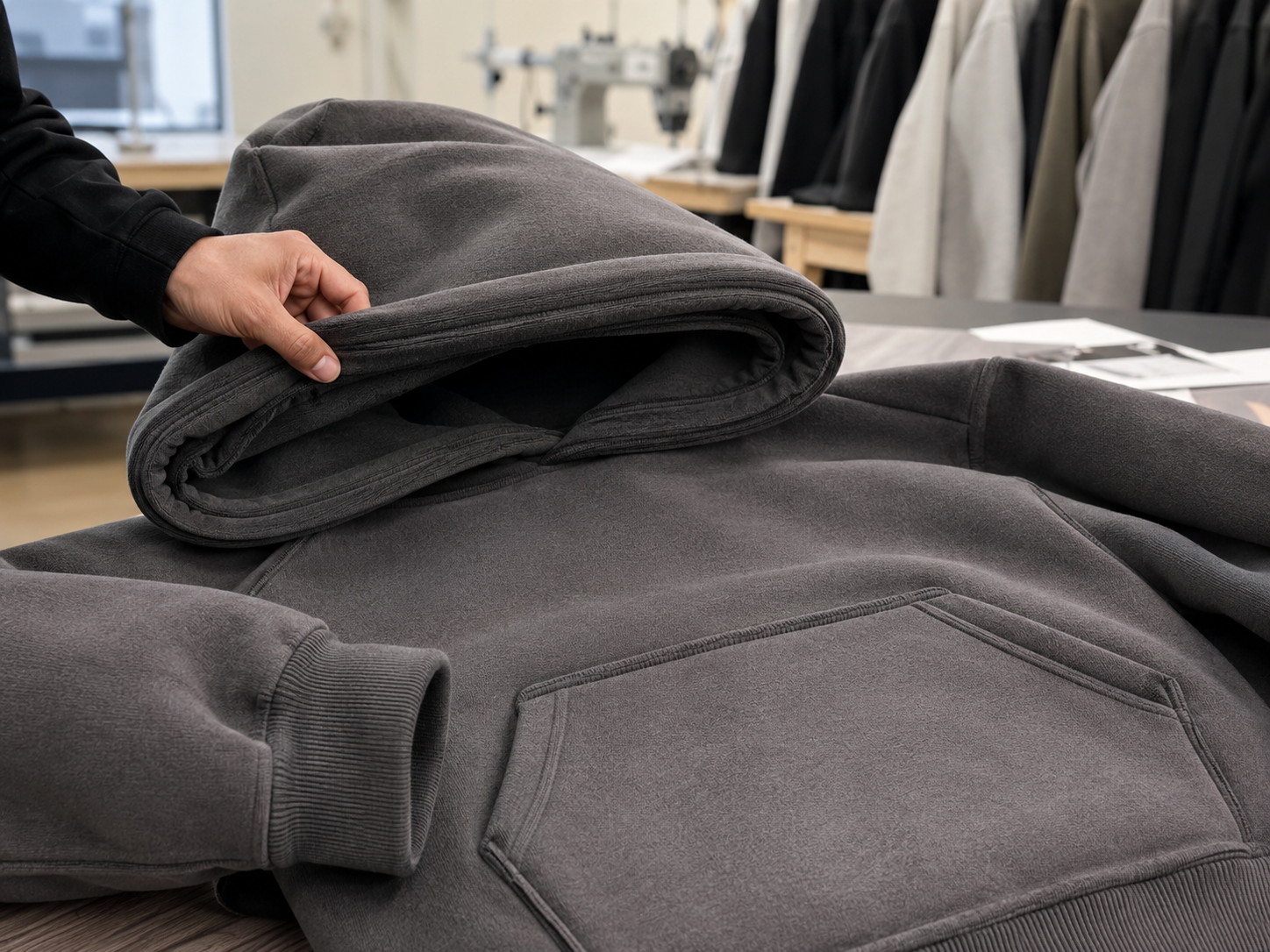
How We Evaluate Heavyweight Hoodie Fabric Before Production
For a new heavyweight hoodie, we prefer evaluating the fabric before moving directly into bulk production.
A typical process is:
Fabric Sourcing
↓
Check GSM & Composition
↓
Evaluate Hand Feel
↓
Check Fleece / Terry Structure
↓
Sample Hoodie
↓
Apply Final Wash if Required
↓
Check Drape & Fit
↓
Approve
↓
Bulk Production
During development, we normally look at:
- Fabric weight
- Thickness
- Softness
- Surface texture
- Inside fleece
- Drape
- Stretch
- Recovery
- Hood structure
- Rib compatibility
- Post-wash hand feel
The sample garment is important because a fabric swatch and a finished hoodie do not always feel the same.
A 10 × 10 cm fabric swatch may feel soft in your hand.
But once that same fabric is used for:
Body + Sleeves + Hood + Pocket + Rib
the full garment may feel significantly heavier and more structured.
That is why sample approval matters.
Frequently Asked Questions
Does higher GSM mean better hoodie quality?
No.
Higher GSM means the fabric is heavier per square meter.
Quality also depends on yarn, knitting, finishing, durability, construction, and the intended design.
Why does my 500 GSM hoodie feel like cardboard?
Possible reasons include high fabric density, firm yarn construction, limited brushing, stiff finishing, or simply too much fabric weight for the chosen construction.
The actual material should be evaluated.
Can a 400 GSM hoodie still feel soft?
Yes.
A well-developed 400 GSM brushed fleece can feel soft and plush while still maintaining a heavyweight structure.
Is French terry stiffer than fleece?
It can feel firmer because the inside is looped rather than heavily brushed.
However, the exact hand depends on the yarn, density, GSM, and finishing.
Can washing make a stiff hoodie softer?
Often it can improve fabric relaxation and hand feel.
However, the result depends on the fabric and wash process.
Washing cannot guarantee that an unsuitable base fabric will become soft enough.
Is 100% cotton always softer than cotton-polyester fleece?
No.
Fiber composition is only one factor.
Yarn, knit construction, brushing, and finishing can have an equally important effect.
Is a double-layer hood too heavy for heavyweight fabric?
Not necessarily.
Double-layer hoods are common in premium streetwear.
But with very high-GSM fabric, the hood can become extremely heavy and rigid.
The construction should be tested on a sample.
What should I ask a manufacturer besides GSM?
Ask about:
- Fiber composition
- Fleece or French terry
- Yarn
- Brushing
- Stretch
- Fabric thickness
- Hand feel
- Shrinkage
- Finishing
- Post-wash result
And whenever possible, request a physical fabric swatch.
Final Recommendation
If a heavyweight hoodie feels too stiff, do not immediately reduce the GSM.
First check what is actually creating the stiffness:
GSM + Density + Yarn + Knit Structure + Fiber Content + Brushing + Finishing + Washing + Garment Construction
Sometimes reducing GSM is the right solution.
But sometimes a different 400 GSM fabric can feel much softer than the original 400 GSM fabric.
From our production experience, the safest workflow is:
Choose Fabric → Check Hand Feel → Make Sample → Apply Final Wash → Wear & Fit Test → Approve → Bulk Production
For premium streetwear, the goal should not simply be:
"Make the hoodie as heavy as possible."
A better target is:
"Make it heavy enough to hold the intended silhouette while still feeling comfortable to wear."
If you are developing heavyweight oversized hoodies, fleece sweatshirts, French terry hoodies, or washed streetwear, Fuki Apparel can help with fabric sourcing, sample development, washing, fit testing, and bulk production.