
DTG is usually better for detailed, full-color artwork and small orders. Screen printing is usually better for bold graphics, larger quantities, specialty inks, and repeat production.
From my experience developing custom streetwear, I do not choose between DTG and screen printing based only on price. I first check the artwork, fabric, order quantity, desired hand feel, and whether the design will be reordered.
Quick answer: Choose DTG for photographic artwork, gradients, many colors, and low-volume testing. Choose screen printing for bold logos, solid colors, large orders, puff effects, and stronger production consistency.
Table of Contents
- Quick Comparison
- What Is DTG Printing?
- What Is Screen Printing?
- Which Method Produces Better Artwork?
- Which Method Is Better for Different Quantities?
- Fabric and Garment Requirements
- Durability and Hand Feel
- Cost Comparison
- How I Choose the Right Method
- Common Printing Mistakes
- Useful Printing Resources
- Frequently Asked Questions
- Final Recommendation
Quick Comparison
| Factor | DTG Printing | Screen Printing |
|---|---|---|
| Best artwork | Photos, gradients, detailed illustrations | Logos, typography, solid graphics |
| Number of colors | Many colors without separate screens | Each color normally needs separate setup |
| Small orders | Very suitable | Setup may make small runs expensive |
| Large orders | Less efficient for some designs | Usually more efficient |
| Print texture | Usually soft and smooth | Depends on ink and number of layers |
| Color consistency | Depends heavily on pretreatment and fabric | Strong for controlled repeat orders |
| Specialty effects | Limited | Puff, high-density, metallic, crack, and more |
| Best fabric | Smooth cotton-rich garments | Works across many suitable fabrics |
| Setup time | Low | Higher because screens must be prepared |
| Best use | Tests, art drops, complex graphics | Core products and volume production |
My Fast Recommendation
Choose DTG when:
- Your artwork contains many colors.
- You need gradients or photographic details.
- You are testing a new design.
- The order quantity is small.
- You want to avoid multiple screen setup charges.
Choose screen printing when:
- Your artwork uses a few solid colors.
- You need a bold and saturated result.
- You are producing a larger order.
- You want puff or high-density effects.
- The product will be reordered regularly.
What Is DTG Printing?
DTG means direct-to-garment printing.
A digital garment printer applies textile ink directly onto the finished garment. The process works in a similar way to an inkjet printer, but it uses inks and equipment developed for clothing.
A typical DTG process includes:
- Preparing the artwork
- Pretreating the garment when required
- Placing the garment on the printer
- Printing the artwork
- Heat-curing the ink
- Inspecting the finished graphic
DTG is especially useful for:
- Photographic artwork
- Detailed illustrations
- Gradients
- Small text
- Multiple colors
- Short product runs
- Personalized garments
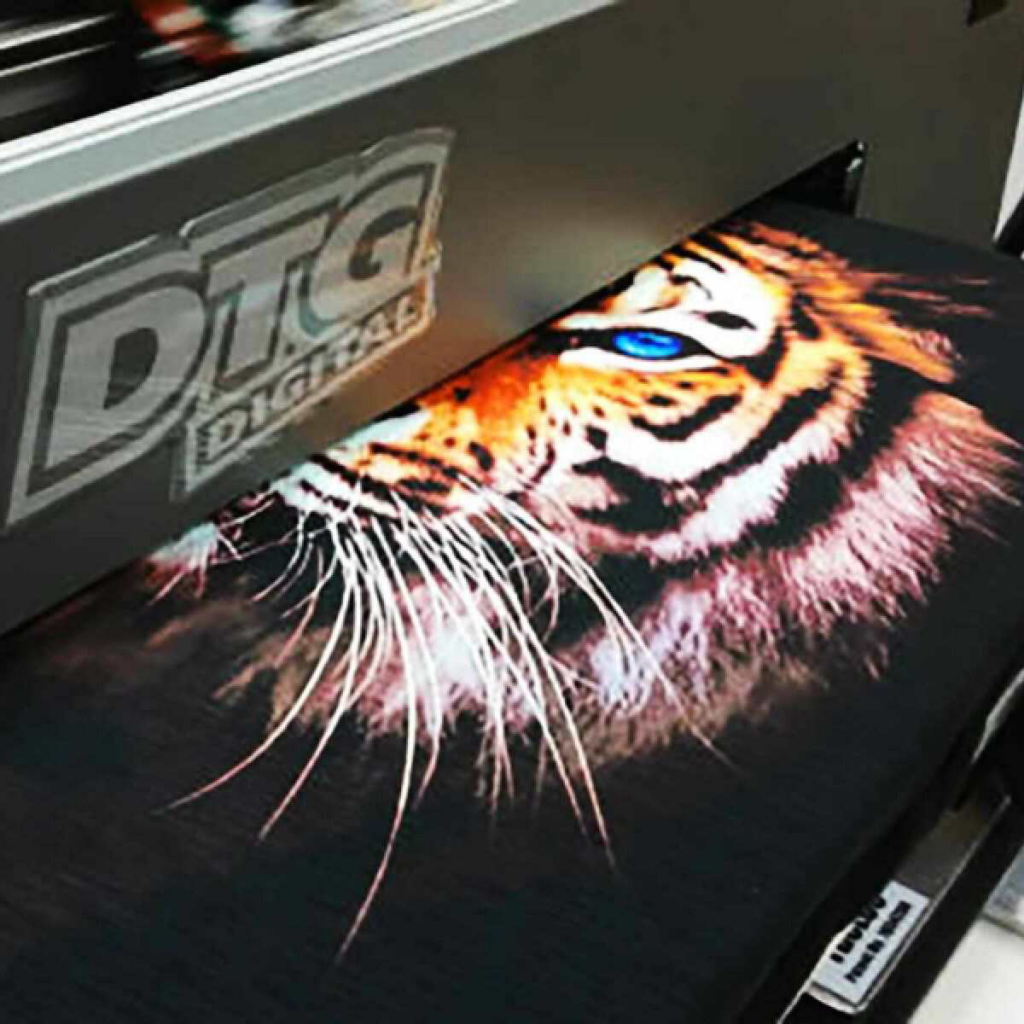
On dark garments, white ink is normally used as an underbase. Epson states that pretreatment is required when its DTG system uses white ink on dark garments. You can read more in the Epson DTG Pretreatment Guide.
Main Advantage of DTG
DTG can reproduce complex artwork without creating a separate screen for every color.
This makes it useful when a design contains:
- Ten or more colors
- Soft shading
- Small color changes
- Photo-like elements
- Artwork that may change frequently
Main Limitation of DTG
The final result depends heavily on:
- Fabric composition
- Surface smoothness
- Pretreatment
- White-ink coverage
- Printer settings
- Curing
A poor-quality or hairy fabric can reduce detail and color clarity.
What Is Screen Printing?
Screen printing pushes ink through a prepared mesh screen onto the garment.
Each color normally requires its own screen. The printer applies the colors one at a time until the complete artwork is formed.
Screen printing works well for:
- Bold logos
- Large typography
- Solid-color graphics
- Front and back prints
- Repeated bulk orders
- Puff printing
- High-density effects
- Specialty inks
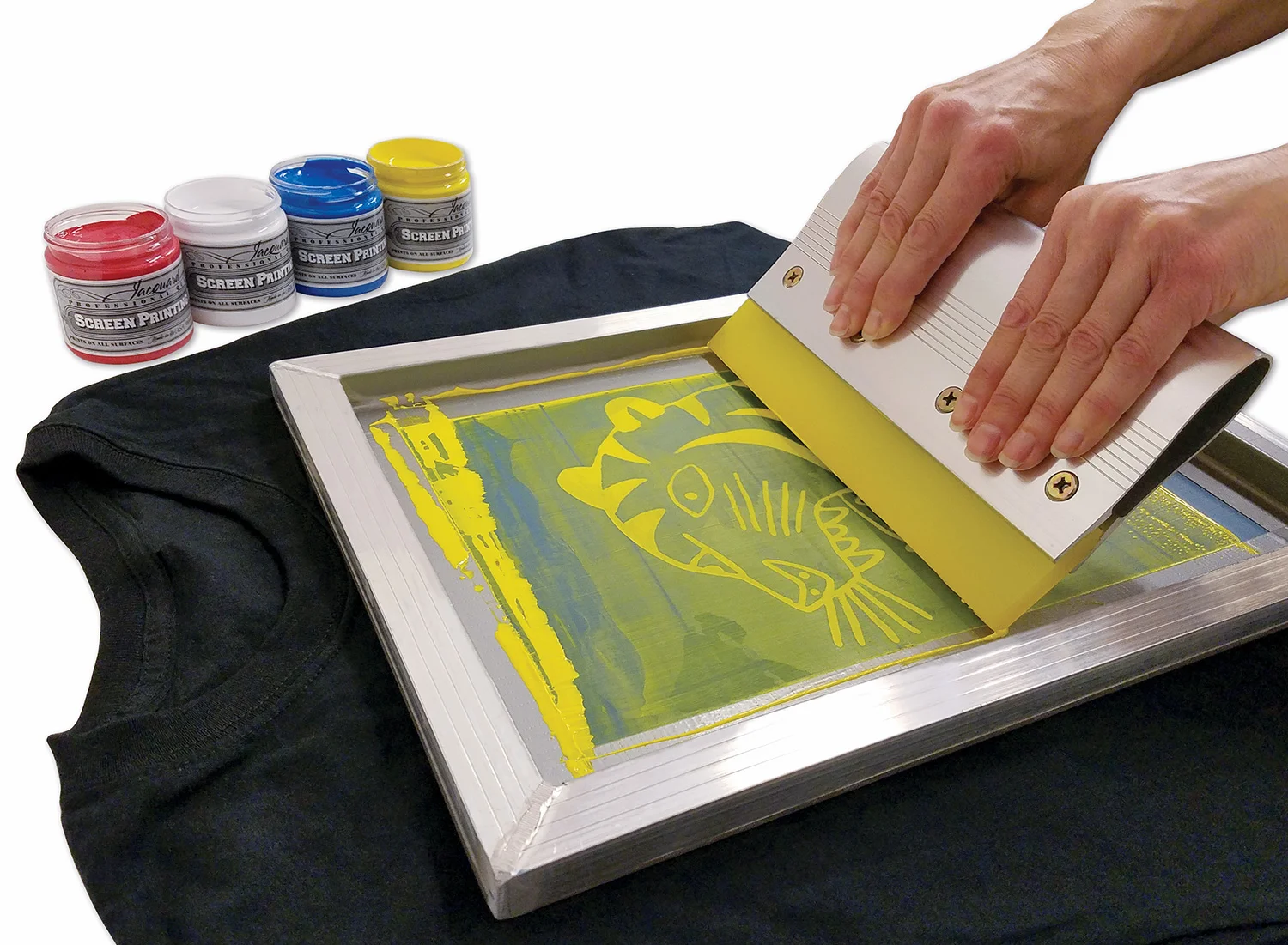
Streetwear brands can explore standard screen print, puff print, DTG, embroidery, and other techniques through FuKi Apparel Custom Printing Services.
Main Advantage of Screen Printing
Once the screens and production settings are prepared, the same artwork can be reproduced efficiently across a larger quantity.
It also gives brands more options for creating texture, including:
- Puff ink
- High-density ink
- Metallic ink
- Crack effects
- Glow effects
- Thick rubberized prints
Main Limitation of Screen Printing
Every additional color can increase:
- Screen preparation
- Color separation work
- Setup time
- Registration difficulty
- Production cost
For a small order containing a detailed ten-color design, screen printing may be less practical than DTG.
Which Method Produces Better Artwork?
Neither method always produces better artwork. The correct choice depends on the design.
| Artwork Type | Better Choice |
|---|---|
| Photographic image | DTG |
| Watercolor-style artwork | DTG |
| Complex gradients | DTG |
| Detailed multicolor illustration | DTG |
| One-color chest logo | Screen printing |
| Large brand lettering | Screen printing |
| Bold two-color back graphic | Screen printing |
| Puff logo | Screen printing |
| Vintage cracked graphic | Screen printing |
| Frequently changing artwork | DTG |
DTG for Complex Color
DTG can print small color variations without preparing many physical screens.
I normally recommend it for:
- Album artwork
- Artist collaborations
- Photo-based graphics
- Highly detailed characters
- Limited test drops
Screen Printing for Bold Impact
Screen printing is usually stronger for simple graphics where opacity, texture, and solid color are more important than photographic detail.
It is often the better option for:
- Oversized logos
- College lettering
- Brand symbols
- Large front or back prints
- Streetwear graphics using two to four colors
For custom graphic garments, see our Custom T-Shirt Manufacturer and Graphic Hoodie Manufacturer services.
Which Method Is Better for Different Quantities?
Order quantity can change the most economical method.
DTG for Small Runs
DTG requires less physical setup, making it useful for:
- Samples
- Small test orders
- Multiple artwork variations
- Personalized garments
- Limited releases
A brand can test several graphics without preparing separate screens for every color in every design.
Screen Printing for Larger Runs
Screen printing normally becomes more efficient after the screens are prepared.
It works especially well when:
- The same artwork is repeated
- The design uses few colors
- The quantity is larger
- Consistent color is important
- The product will be reordered
Simple Quantity Guide
| Order Situation | Suggested Method |
|---|---|
| One development sample | DTG or digital print test |
| Small full-color art drop | DTG |
| Several designs in low quantities | DTG |
| 100-piece one-color logo order | Screen printing |
| Large two-color graphic order | Screen printing |
| Regular repeat production | Screen printing |
| Small personalized order | DTG |
This is a planning guide, not a fixed rule. Artwork size, fabric, printer capacity, and local setup costs can change the final decision.
Fabric and Garment Requirements
Best Fabric for DTG
DTG generally performs best on smooth cotton or cotton-rich fabric.
A good DTG fabric should have:
- A smooth print surface
- Low hairiness
- Stable construction
- Good ink absorption
- Consistent pretreatment response
Polyester and blended fabrics may require different pretreatment and curing methods. Brother recommends testing new substrates before production because blends may not achieve the same results as suitable cotton garments.
See the Brother DTG Substrate Guide for more technical information.
Best Fabric for Screen Printing
Screen printing works on a wider variety of suitable garments, including:
- Cotton jersey
- French terry
- Fleece
- Cotton-polyester blends
- Denim
- Twill
- Nylon with compatible ink
The printer must select an ink system that matches the fabric.
For example, polyester-rich fabric may create dye-migration problems if the print process is not properly controlled.
Should You Print Before or After Garment Washing?
The production order depends on the design and wash treatment.
Garment washing can change:
- Print color
- Surface texture
- Adhesion
- Cracking
- Fabric dimensions
Always test the actual production sequence. Brands developing faded products can review our Washed T-Shirts Manufacturer options.
Durability and Hand Feel
Both methods can be durable when the fabric, ink, pretreatment, and curing process are correct.
DTG Hand Feel
DTG often creates a softer print because the ink is applied digitally in controlled layers.
However, dark garments may require pretreatment and white ink, which can make the printed area feel more noticeable.
Screen-Print Hand Feel
Screen-print texture depends on:
- Ink type
- Number of layers
- Underbase
- Print size
- Mesh selection
- Curing
A light water-based print can feel soft. A large plastisol or high-density print can feel much thicker.
What Causes Print Failure?
Both techniques may fail because of:
- Incorrect curing
- Poor fabric compatibility
- Weak pretreatment
- Excessive heat
- Inaccurate washing
- Dye migration
- Poor-quality ink
- Insufficient testing
I recommend washing the finished print sample before approving bulk production.
Cost Comparison
The cheaper method depends on the artwork and quantity.
DTG Cost Structure
DTG cost is influenced by:
- Print size
- Ink coverage
- White ink
- Pretreatment
- Garment color
- Printing time
Adding more artwork colors does not require more physical screens.
Screen-Printing Cost Structure
Screen-print cost is influenced by:
- Number of colors
- Number of screens
- Print placements
- Ink type
- Setup time
- Order quantity
The cost per piece normally becomes more competitive as the same design is repeated across more garments.
Cost Decision Table
| Production Requirement | Usually More Practical |
|---|---|
| Small quantity with many colors | DTG |
| Large quantity with few colors | Screen printing |
| Several artwork variations | DTG |
| One repeated brand graphic | Screen printing |
| Puff or specialty ink | Screen printing |
| Photo-quality design | DTG |
Request quotations using the exact artwork, size, fabric, garment color, and quantity. Comparing only the names “DTG” and “screen print” will not produce an accurate cost comparison.
How I Choose the Right Method
I use five questions.
1. How Detailed Is the Artwork?
Choose DTG for gradients, photos, and many small color changes.
Choose screen printing for bold, separated color areas.
2. How Many Pieces Are Required?
Choose DTG for low-volume artwork testing.
Choose screen printing for larger repeated orders.
3. What Fabric Is Being Used?
Smooth cotton-rich fabrics are usually the safest DTG starting point.
Screen printing provides more ink choices for different garment materials.
4. What Should the Print Feel Like?
Choose DTG for a generally softer digital result.
Choose screen printing when you want a specific texture, such as puff or high density.
5. Will the Design Be Reordered?
For a stable core product, screen printing may provide stronger repeat efficiency.
For changing artwork and limited drops, DTG may provide more flexibility.
Common Printing Mistakes
Choosing DTG Only Because the Artwork Has Many Colors
The fabric, garment color, pretreatment, and desired opacity must also be considered.
Choosing Screen Printing Only Because It Is Traditional
A highly detailed, low-volume illustration may be easier and more economical with DTG.
Approving From a Digital Mockup
A mockup cannot show hand feel, ink coverage, pretreatment marks, or fabric reaction.
Testing on the Wrong Fabric
The approved sample should use the same fabric and color planned for production.
Ignoring Dark-Garment Pretreatment
Dark DTG garments often require pretreatment and a white underbase. Poor application can affect color and surface consistency.
Comparing Prices Without Matching Artwork
A small DTG print and a large multicolor screen print are not equal specifications.
Useful Printing Resources
- Epson DTG Printing Overview
- Epson DTG Pretreatment Guide
- Brother DTG Fabric Guide
- PRINTING United Alliance
- FuKi Apparel Custom Printing Services
Frequently Asked Questions
Is DTG better than screen printing?
DTG is better for detailed full-color artwork and small orders. Screen printing is better for bold graphics, specialty effects, and larger repeat quantities.
Which method lasts longer?
Both can be durable when correctly produced. Durability depends on fabric preparation, ink, curing, washing, and customer care.
Is DTG good for streetwear?
Yes. It is especially useful for detailed art drops, artist collaborations, photographic graphics, and small-volume testing.
Is screen printing better for hoodies?
Screen printing is often a strong choice for hoodies because it supports bold graphics, opaque colors, puff effects, and heavyweight fabrics.
Can DTG print on black T-shirts?
Yes. Dark garments normally require pretreatment and white ink beneath the colored artwork.
Can DTG print photographs?
Yes. Photographic and gradient-based artwork is one of DTG’s strongest applications.
Which method is cheaper?
DTG is often more practical for small full-color orders. Screen printing is often more economical for larger quantities using fewer colors.
Final Recommendation
Choose DTG printing when you need:
- Detailed artwork
- Photographic images
- Gradients
- Many colors
- Small test quantities
- Multiple design variations
Choose screen printing when you need:
- Bold solid graphics
- Larger production quantities
- Strong repeat consistency
- Puff or specialty inks
- High-opacity prints
- Core streetwear products
My main recommendation is:
Use DTG when artwork complexity is the main challenge. Use screen printing when production scale, opacity, texture, and repeatability are the main priorities.
Always approve the design on the actual garment fabric and complete a wash test before bulk production.
FuKi Apparel supports streetwear brands with DTG, screen printing, puff printing, embroidery, garment washing, private labels, packaging, and bulk manufacturing.
Visit FuKi Apparel or explore Custom Streetwear Printing Services to discuss the right method for your design.
