
The best printing for streetwear depends on the artwork, fabric, order quantity, desired texture, wash process, and target price.
From my experience developing custom streetwear, screen printing is the best all-around choice for most brands. It produces bold colors, supports specialty effects, and becomes commercially efficient when the same design is produced in a practical quantity.
However, it is not the best choice for every project.
- Choose screen printing for bold graphics and repeat production.
- Choose DTG for detailed, full-color artwork and smaller drops.
- Choose DTF for flexible testing across several fabrics.
- Choose puff printing for soft, raised lettering.
- Choose high-density printing for sharper raised graphics.
- Choose water-based printing for a softer hand feel.
- Choose sublimation for polyester and all-over designs.
The best streetwear print is not the most complicated technique. It is the method that reproduces the artwork clearly, suits the fabric, survives washing, and remains commercially practical at the required quantity.
Table of Contents
- Quick Printing Decision Table
- What Is the Best Printing for Streetwear?
- Use the Five-Factor Selection Method
- Best Printing by Artwork Type
- Best Printing by Garment and Fabric
- Best Printing by Order Quantity
- Best Printing by Brand Positioning
- How Printing Changes Product Cost
- How to Approve a Streetwear Print Sample
- Printing Mistakes That Reduce Product Quality
- Frequently Asked Questions
- Final Recommendation
Quick Printing Decision Table
| Brand Requirement | Recommended Printing Method |
|---|---|
| Bold one- or two-color graphic | Screen printing |
| Large back print for bulk production | Screen printing |
| Detailed illustration with gradients | DTG |
| Small full-color test order | DTG or DTF |
| Raised college-style lettering | Puff printing |
| Sharp raised logo | High-density printing |
| Soft premium print | Water-based printing |
| Vintage print on suitable dark cotton | Discharge printing |
| Flexible technical logo | Silicone printing |
| Polyester all-over design | Sublimation |
| Mixed fabrics and several small designs | DTF |
My Fast Recommendation
For a new streetwear collection, I normally start with:
- Screen printing for the main graphic
- Small embroidery for premium branding
- Puff printing for one selected statement design
- DTG or DTF for low-volume artwork testing
This gives the collection visual variety without introducing too many production processes.
FuKi Apparel offers screen print, puff print, silicone print, DTG, embroidery, and related techniques through its Custom Streetwear Printing Service.
What Is the Best Printing for Streetwear?
For most streetwear brands, screen printing is the best overall method.
It works particularly well for:
- Graphic T-shirts
- Heavyweight hoodies
- Sweatshirts
- Sweatpants
- Cotton tote bags
- Large front and back artwork
- Repeat production
Screen printing can produce strong solid colors and support several specialty ink systems.
Possible effects include:
- Standard plastisol
- Water-based ink
- Puff ink
- High-density ink
- Crack ink
- Metallic ink
- Reflective ink
Its main limitation is setup. Each color and placement may require separate preparation, so highly detailed artwork with many colors may be less practical for a very small order.
When Screen Printing Is Not the Best Choice
Do not automatically choose screen printing when:
- The artwork contains photographic detail.
- The design uses many gradients.
- Every garment has a different graphic.
- The first order is extremely small.
- The fabric cannot tolerate the required curing process.
- A very soft digital appearance is required.
In these situations, DTG, DTF, water-based printing, or sublimation may be more suitable.
The PRINTING United Alliance Apparel Decoration Resource provides broader industry information about screen printing, digital printing, sublimation, embroidery, and other apparel-decoration processes.
Use the Five-Factor Selection Method
I use five questions before recommending any printing technique.
1. What Does the Artwork Look Like?
Check:
- Number of colors
- Fine lines
- Small text
- Gradients
- Photographic details
- Solid filled areas
- Graphic dimensions
2. What Fabric Will Be Printed?
Confirm:
- Fiber composition
- Fabric weight
- Surface smoothness
- Stretch
- Heat sensitivity
- Garment color
- Wash treatment
3. How Many Pieces Are Required?
Some methods require more setup but become efficient in repeat production. Others have lower setup requirements but may have a higher cost per print.
4. What Should the Print Feel Like?
The print may need to feel:
- Soft
- Flat
- Thick
- Rubberized
- Raised
- Distressed
- Almost invisible on the fabric
5. What Will Happen After Printing?
Confirm whether the garment will be:
- Enzyme washed
- Pigment washed
- Acid washed
- Distressed
- Heat pressed
- Brushed
- Regularly machine washed
The printing sequence must be tested when the garment also receives a strong wash treatment.
Artwork chooses the print method, fabric controls the result, and production quantity determines whether the method is commercially practical.
Best Printing by Artwork Type
Bold Logos and Typography
Choose screen printing for:
- Brand logos
- Large slogans
- College lettering
- Simple illustrations
- One- to four-color graphics
Screen printing usually provides strong opacity and clear spot colors.
Photographs and Detailed Illustrations
Choose DTG when the artwork contains:
- Photographs
- Gradients
- Shadows
- Fine color changes
- Painterly illustrations
- Many colors
DTG prints directly onto the garment using a digital textile printer.
Dark garments commonly require white ink and pretreatment. The Epson DTG Pretreatment Guide explains that pretreatment is required when white ink is used on black or dark garments.
Small Full-Color Logos
Choose DTF when you need:
- Small colorful graphics
- Multiple artwork variations
- Mixed garment materials
- A controlled first order
- Strong color opacity
DTF prints the artwork onto film before transferring it to the garment with heat and adhesive.
I prefer DTF for small or medium-sized placements. A very large DTF graphic may create a noticeable surface layer and reduce breathability.
Raised Graphics
Choose puff printing for:
- Rounded lettering
- Large brand initials
- Soft three-dimensional graphics
- Retro streetwear logos
Choose high-density printing for:
- Sharper raised edges
- Geometric shapes
- Technical logos
- Controlled print height
Puff ink expands during curing. High-density printing builds more structured layers.
Soft Vintage Artwork
Choose water-based or discharge printing when the design needs:
- A softer surface
- A faded appearance
- Less heavy ink buildup
- A vintage hand feel
Discharge printing depends on the fabric, dye, and garment color. It should be tested on the actual bulk fabric because not every dark cotton garment reacts in the same way.
Best Printing by Garment and Fabric
The same design can produce different results on cotton jersey, fleece, polyester, or nylon.
| Product | Practical Printing Choice |
|---|---|
| Cotton graphic T-shirt | Screen print, DTG, or water-based print |
| Heavyweight oversized T-shirt | Screen print, puff, or high density |
| Washed T-shirt | Tested screen print or water-based print |
| French terry hoodie | Screen print, puff, silicone, or DTF |
| Brushed fleece hoodie | Screen print or tested transfer |
| Polyester jersey | Sublimation |
| Nylon jacket | Compatible transfer, silicone, or specialized ink |
| Technical cargo pants | Silicone or small compatible transfer |
| Stretch fabric | Flexible silicone or tested transfer |
Oversized T-Shirts
Oversized T-shirts provide enough surface area for:
- Large back graphics
- Center chest prints
- Wide typography
- Multi-placement artwork
A smooth cotton surface usually produces cleaner detail than a hairy or irregular surface.
Explore suitable fits and fabrics through FuKi Apparel Oversized T-Shirt Manufacturing.
Heavyweight Hoodies
Heavyweight hoodies can support:
- Large screen prints
- Puff prints
- High-density logos
- Silicone graphics
- Mixed print and embroidery
However, very thick decoration can make the garment stiff. I recommend controlling the number and size of large print placements.
Review hoodie development options through FuKi Apparel Graphic Hoodie Manufacturing.
Washed Garments
A washed product needs a confirmed production sequence.
Two common directions are:
- Wash first, then print: better for a clean and stable graphic
- Print first, then wash: better for an intentionally aged graphic
For vintage products, see FuKi Apparel Washed T-Shirt Manufacturing.
Best Printing by Order Quantity
Order quantity affects setup cost, unit cost, and production flexibility.
| Order Situation | Practical Starting Method |
|---|---|
| One-off sample | DTG, DTF, or digital transfer |
| Small design test | DTG or DTF |
| Small order with simple artwork | Compare screen print and DTF |
| Medium repeat order | Screen printing |
| Large repeat order | Screen printing |
| Many different designs | DTG or DTF |
| Polyester team or jersey order | Sublimation |
Small Orders
DTG and DTF are useful when:
- The brand is testing demand.
- The design has many colors.
- Several graphics are being launched.
- Screen setup would be too expensive.
Medium and Large Orders
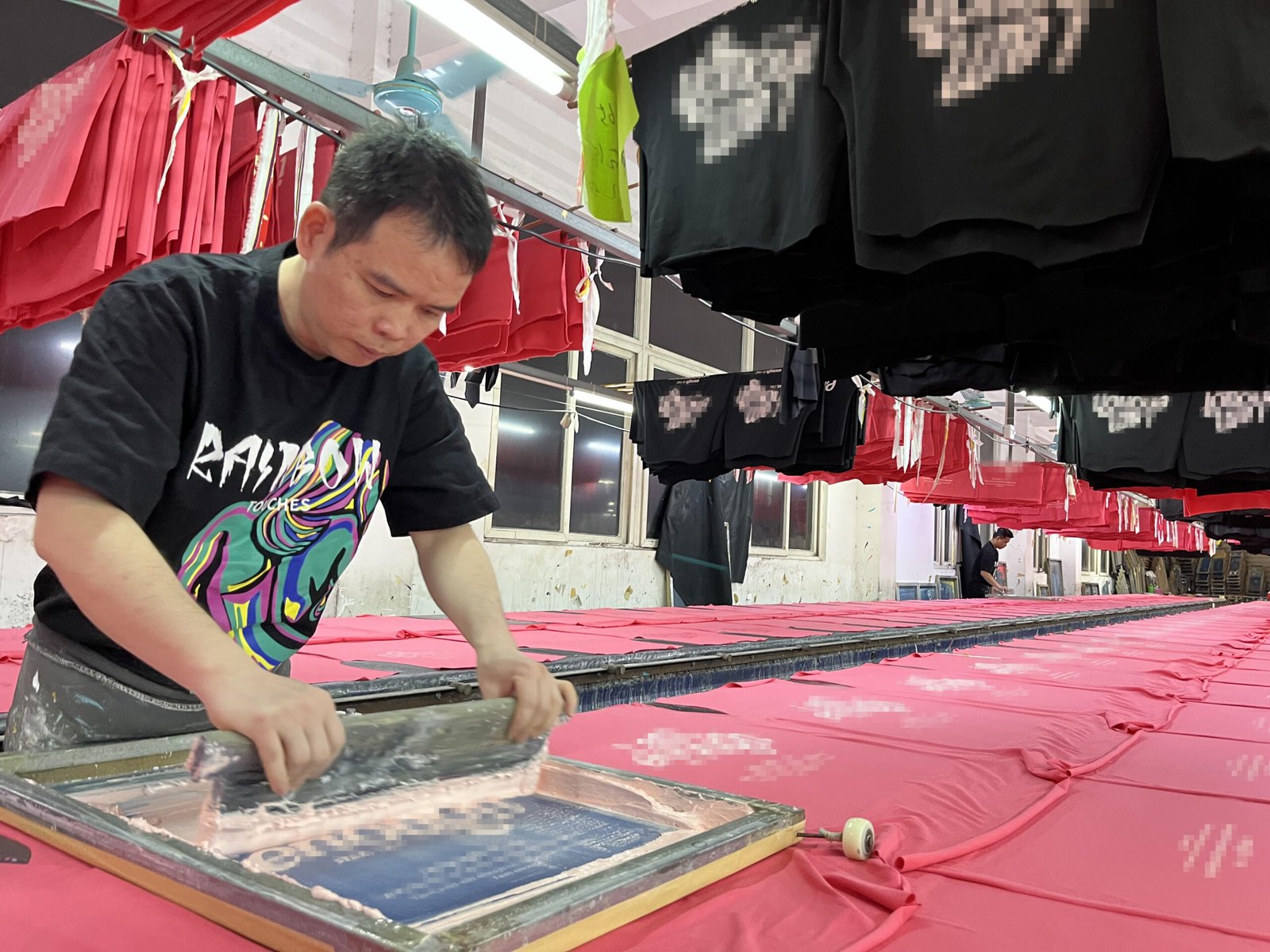
Screen printing normally becomes more practical when:
- The artwork remains the same.
- Color separations are controlled.
- The order can spread the setup cost across more units.
- Consistent repeat production is required.
Do not increase the order only to reduce the print price. Unsold inventory costs more than a slightly higher printing cost per garment.
Best Printing by Brand Positioning
Graphic-Led Streetwear Brand
Use:
- Screen printing for core graphics
- DTG for artist collaborations
- Puff for selected statement pieces
Premium Minimal Brand
Use:
- Small water-based prints
- Silicone logos
- High-density branding
- Print combined with embroidery
The print should support the fabric and silhouette rather than dominate them.
Vintage Streetwear Brand
Use:
- Water-based printing
- Discharge printing
- Distressed screen printing
- Printing combined with garment washing
Technical Streetwear Brand
Use:
- Silicone printing
- Reflective print
- Compatible heat transfers
- Sublimation on suitable polyester products
Startup Testing Several Designs
Use:
- DTG
- DTF
- Limited screen-print runs
- One standard blank or custom body
Once a design proves demand, move it to a more efficient repeat-production method.
How Printing Changes Product Cost
Printing cost is influenced by:
- Artwork dimensions
- Number of colors
- Number of placements
- Order quantity
- Ink type
- Fabric
- Curing requirements
- Manual finishing
- Wash testing
Details That Increase Cost
| Design Decision | Cost Effect |
|---|---|
| More print colors | More setup and registration |
| More placements | Separate production operations |
| Larger print area | More ink and handling |
| Specialty ink | More testing and material cost |
| Small order | Setup is divided across fewer units |
| Printing after washing | Additional handling |
| Detailed color matching | More sampling and adjustment |
How I Control Printing Cost
I normally recommend:
- One main print placement
- One smaller supporting logo
- Fewer spot colors
- One shared print method across several products
- Physical approval before bulk production
Reducing unnecessary print placements can lower cost without weakening the product identity.
How to Approve a Streetwear Print Sample
Never approve printing only from a digital mockup.
A mockup cannot accurately show:
- Ink thickness
- Surface texture
- Real color
- Fabric reaction
- Print flexibility
- Breathability
- Wash performance
- Raised-print height
Print Approval Checklist
| Inspection Area | What to Check |
|---|---|
| Artwork size | Matches the approved dimensions |
| Placement | Correct distance from seams and edges |
| Color | Matches the agreed reference |
| Detail | Small text and lines remain clear |
| Coverage | No unwanted fabric show-through |
| Texture | Correct softness, gloss, or height |
| Fabric condition | No scorching or distortion |
| Stretch | Print performs during normal movement |
| Wash result | No serious peeling, cracking, or fading |
| Repeatability | Bulk process can match the sample |
Keep:
- The approved physical print
- Final artwork file
- Color references
- Placement measurements
- Ink or technique record
- Wash-test result
The AATCC Standard Laundering Resource provides information about standardized washing conditions used in textile evaluation.
FuKi Apparel supports material, decoration, in-line, and final checks through its Streetwear Quality Control Service.
Printing Mistakes That Reduce Product Quality
Choosing the Method Before Reviewing the Artwork
Start with the visual result, fabric, and quantity.
Using Puff Print for Fine Details
Expansion can close narrow spaces and make small text unclear.
Using Large DTF Graphics on Lightweight T-Shirts
The transfer may feel heavy and affect drape and breathability.
Ignoring the Fabric Surface
A rough or hairy surface can reduce print definition.
Printing on Polyester Without Migration Testing
Heat can cause polyester dye to move into the printed area. Use compatible materials and test the actual fabric color.
Approving a Different Fabric
The print test should use the same fabric, color, finish, and wash process planned for bulk production.
Skipping the Wash Test
A new print may look correct but fail after laundering.
Adding Too Many Techniques
Screen print, puff, silicone, DTF, embroidery, and patches do not all need to appear on one product.
One carefully developed technique normally creates a stronger result than several poorly connected effects.
Frequently Asked Questions
What is the best printing for streetwear?
Screen printing is the best all-around choice for many streetwear brands because it supports bold graphics, specialty effects, and repeat production.
What printing is best for small streetwear orders?
DTG and DTF are practical for small orders, especially when the artwork uses many colors or several design variations.
What printing is best for oversized T-shirts?
Screen printing is ideal for large bold graphics. DTG is better for photographic artwork, while puff printing works well for raised lettering.
What printing is best for heavyweight hoodies?
Screen printing, puff printing, high-density printing, silicone printing, and selected transfers can all work on stable heavyweight hoodie fabric.
Is DTG or screen printing better?
Choose DTG for small full-color orders and detailed artwork. Choose screen printing for bold designs, specialty inks, and larger repeat orders.
Is DTF good for premium streetwear?
DTF can produce strong color and detail, but its surface feel must suit the product. It is usually more effective for controlled placements than very large premium graphics.
Which print has the softest hand feel?
Water-based, discharge, DTG, and sublimation can produce soft results. The final feel depends on the fabric, ink system, coverage, and curing process.
How can I make streetwear printing last longer?
Use a compatible fabric and ink system, control pretreatment and curing, approve a physical test, and complete wash testing before bulk production.
Final Recommendation
Choose:
- Screen printing for the best overall streetwear solution
- DTG for detailed full-color artwork
- DTF for flexible small-order testing
- Puff printing for soft raised lettering
- High-density printing for sharp three-dimensional graphics
- Water-based printing for a softer premium surface
- Discharge printing for tested vintage cotton garments
- Silicone printing for technical branding
- Sublimation for polyester and all-over designs
My final recommendation is:
Choose printing by artwork first, fabric second, order quantity third, and trend last.
The method should make the design clearer, not merely more complicated. Always approve the actual print on the intended production fabric and complete a wash test before bulk manufacturing.
FuKi Apparel supports streetwear brands with custom fabrics, screen printing, puff printing, DTG, silicone printing, embroidery, garment washing, private labels, quality control, packaging, and bulk production.
Visit FuKi Apparel or contact our streetwear production team to select and test the right printing method for your collection.