
Heavyweight T-shirts are now common in premium streetwear.
Brands often choose fabrics such as:
220 GSM
260 GSM
or even:
300 GSM+ cotton jersey
because they want a thicker hand feel and stronger oversized silhouette.
But once the fabric is selected, another question appears:
Should we use screen printing or DTG?
Both methods can produce high-quality graphics.
But they work very differently.
Screen printing transfers ink through a mesh screen.
DTG, or Direct-to-Garment printing, uses a digital printer to apply ink directly onto the fabric.
For heavyweight streetwear, the better option depends on:
Fabric Surface + Artwork + Quantity + Color Count + Pretreatment + Desired Hand Feel
From our production experience, GSM alone should never decide the printing method.
Table of Contents
- What Is Screen Printing?
- What Is DTG Printing?
- 1. Heavyweight Fabric Usually Gives Screen Printing a Stable Base
- 2. DTG Depends More on Fabric Surface Than GSM
- 3. Which Method Produces Better Fine Detail?
- 4. Which Method Works Better on Dark Heavyweight T-Shirts?
- 5. Screen Print and DTG Feel Different on the Garment
- 6. Which Method Is Better for Large Graphics?
- 7. Which Is Better for Small Orders?
- 8. Which Is Better for Bulk Production?
- 9. Wash Durability Depends on Production Control
- Screen Print vs DTG Comparison
- How We Choose the Printing Method Before Production
- Frequently Asked Questions
- Final Recommendation
What Is Screen Printing?
Screen printing uses a mesh screen to transfer ink onto the garment.
For traditional spot-color printing, each ink color usually requires its own screen.
A typical process looks like:
Artwork
↓
Color Separation
↓
Screen Preparation
↓
Ink Mixing
↓
Printing
↓
Flashing if Required
↓
Curing
Screen printing is widely used for heavyweight streetwear because it can create:
- Strong color coverage
- Large graphics
- Puff prints
- High-density effects
- Specialty inks
- Repeatable bulk production
It is especially useful when the design contains a limited number of solid colors.
For more information:
Custom Streetwear Printing Services
You can also read:
Why Does a Screen Print Need So Many Screens?
What Is DTG Printing?
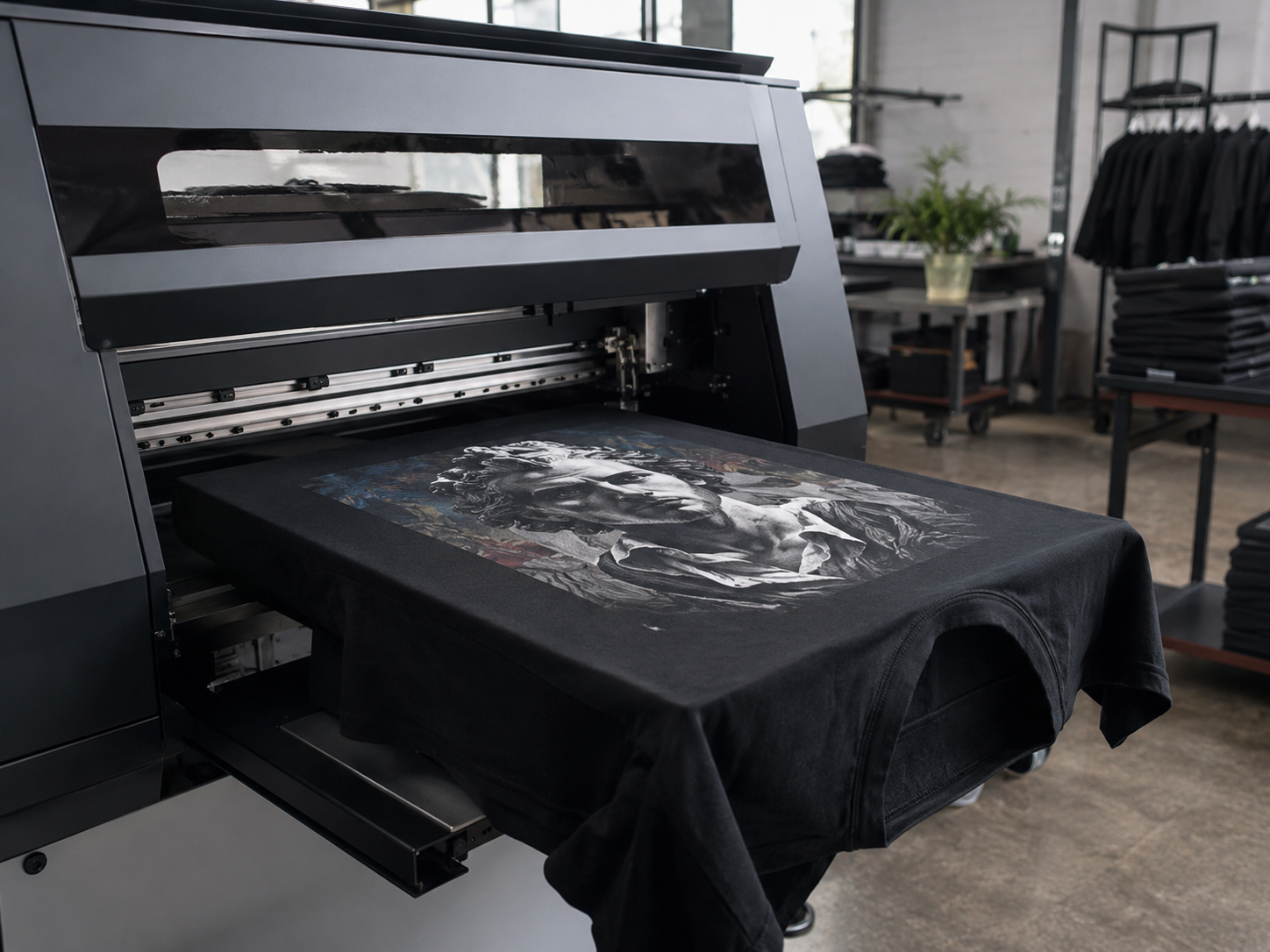
DTG means:
Direct-to-Garment
Instead of preparing a separate physical screen for each color, a digital garment printer applies textile ink directly onto the T-shirt.
The process is similar in concept to digital inkjet printing, but it uses inks and production settings designed for garments.
A typical DTG workflow may include:
Artwork
↓
Garment Pretreatment if Required
↓
Printing
↓
Curing / Heat Pressing
↓
Inspection
DTG is particularly useful for:
- Full-color artwork
- Photographic graphics
- Gradients
- Small production quantities
- Artwork with many colors
For dark garments, pretreatment is normally an important part of obtaining a good white base and color performance.
1. Heavyweight Fabric Usually Gives Screen Printing a Stable Base
Heavyweight T-shirts often provide a stable printing surface.
A thicker cotton jersey can support:
- Large screen prints
- Multiple ink layers
- Puff printing
- High-density printing
without feeling as delicate as a very lightweight T-shirt.
For example:
A 260 GSM oversized cotton T-shirt can work very well with a large back screen print because the fabric has enough body to support the decoration.
However, heavyweight fabric does not automatically guarantee a better print.
The printer still needs to consider:
- Surface texture
- Yarn
- Fabric finishing
- Ink deposit
- Mesh count
- Curing
A rough 300 GSM fabric may print less sharply than a smoother 240 GSM fabric.
So:
Heavyweight ≠ Automatically Better Printing Surface
2. DTG Depends More on Fabric Surface Than GSM
DTG printing is very sensitive to the face of the fabric.
The printer is applying very small droplets of ink directly onto the textile surface.
If the fabric surface is:
- Smooth
- Clean
- Stable
- Cotton-rich
the graphic can usually reproduce more detail.
If the surface is:
- Very fuzzy
- Heavily brushed
- Rough
- Uneven
the final print may appear less sharp.
This is why GSM alone is not enough.
For example:
300 GSM Smooth Cotton Jersey
may work better for DTG than:
260 GSM Very Hairy or Rough Jersey
even though the second fabric is lighter.
For DTG streetwear, we normally want to evaluate the actual production fabric before confirming the printing method.
3. Which Method Produces Better Fine Detail?
DTG is often strong when the artwork contains:
- Fine shading
- Photographic details
- Gradients
- Many colors
- Small color transitions
Because it is digitally printed, the artwork does not need to be separated into one traditional screen for every spot color.
This makes DTG useful for complex illustrations.
DTG Works Well For:
- Photographs
- Detailed artwork
- Gradient graphics
- Multi-color illustrations
Screen Printing Works Well For:
- Bold typography
- Solid colors
- Large logos
- Graphic streetwear designs
Screen printing can also reproduce fine detail through:
- Halftones
- Simulated process printing
- CMYK process printing
but more complex separations may require additional screens and setup.
If the artwork is extremely detailed, the final method should be chosen after reviewing the actual file.
4. Which Method Works Better on Dark Heavyweight T-Shirts?
Dark heavyweight T-shirts create additional printing challenges.
Screen Printing
On black garments, screen printers often use:
White Underbase
↓
Top Colors
The underbase prevents the dark fabric from reducing the brightness of the top colors.
This usually provides strong opacity.
DTG
Dark-garment DTG typically also requires a white ink base.
The garment may need pretreatment so the white ink can sit properly on the fabric instead of absorbing excessively into the fibers.
If pretreatment is:
- Uneven
- Too light
- Too heavy
the finished print can show problems such as:
- Uneven white
- Poor color brightness
- Visible pretreatment marks
- Reduced consistency
This is why DTG quality depends heavily on the complete printing workflow.
5. Screen Print and DTG Feel Different on the Garment
The two techniques can create different hand feels.
Screen Print
The hand feel depends on:
- Ink type
- Underbase
- Number of layers
- Print coverage
A large opaque screen print may feel more noticeable on the surface.
Specialty effects such as:
- Puff
- High-density
- Gel
can create even more texture.
DTG
DTG can create a softer result in some designs because the ink is applied digitally rather than through multiple thick spot-color layers.
However, a dark-garment DTG print with:
- Pretreatment
- White base
- High ink coverage
can still have a noticeable surface feel.
So it is not accurate to say:
DTG is always softer.
The final hand feel depends on the actual print construction.
6. Which Method Is Better for Large Graphics?
Both methods can produce large graphics.
But the production experience can be different.
Screen Printing
Large streetwear graphics are extremely common.
It works well for:
- Large back prints
- Oversized typography
- Bold front graphics
Once the screens are prepared, the same graphic can be repeatedly printed across a bulk order.
DTG
DTG can also produce large graphics, especially when the artwork contains:
- Multiple colors
- Complex gradients
- Photographic detail
However, large high-coverage graphics use more ink and increase printing time.
The artwork should also be tested to make sure the printed area does not feel too heavy.
For a simple large two-color streetwear graphic, screen printing is often very efficient.
For a complex full-color illustration, DTG may simplify artwork preparation.
7. Which Is Better for Small Orders?
DTG often becomes attractive for smaller quantities.
Why?
Traditional screen printing requires setup.
For example, a six-color artwork may require:
- Six color separations
- Multiple screens
- Registration
- Ink preparation
That setup is required whether the order contains:
20 T-shirts
or:
500 T-shirts
With DTG, there are no traditional screens to prepare for each color.
This can make it useful for:
- Samples
- Small drops
- Test collections
- One-off graphics
- Many designs with low quantities
However, DTG still requires:
- File preparation
- Pretreatment where required
- Printing
- Curing
So it is not a completely setup-free process.
8. Which Is Better for Bulk Production?
For larger quantities, screen printing often becomes more production-efficient.
Once the screens are:
- Prepared
- Registered
- Tested
the same design can be printed repeatedly.
This makes screen printing especially suitable for:
- 100 pieces
- 300 pieces
- 500 pieces
- Larger repeated orders
depending on the artwork.
DTG prints garments individually.
That makes production speed more directly tied to:
- Print size
- Ink coverage
- Number of garments
- Printer capacity
For a simple streetwear logo printed across a large production order, screen printing is often a practical option.
For a full-color design with many shades, the calculation may be different.
9. Wash Durability Depends on Production Control
A common question is:
"Does screen print last longer than DTG?"
There is no single answer for every print.
Durability depends on:
- Ink system
- Fabric
- Pretreatment
- Curing
- Washing
- Drying
- Production control
A poorly cured screen print can fail.
A poorly pretreated or cured DTG print can also fail.
Common print problems may include:
- Cracking
- Fading
- Peeling
- Poor adhesion
- Color loss
This is why wash testing matters.
For a new artwork or fabric combination, the safest process is:
Print Sample → Cure → Wash Test → Inspect → Approve
instead of judging durability only from a fresh sample.
Screen Print vs DTG Comparison
| Factor | Screen Print | DTG |
|---|---|---|
| Solid Colors | Excellent | Good |
| Photographic Detail | Possible with advanced separation | Excellent |
| Gradients | Requires halftone/separation | Very suitable |
| Small Quantity | More setup required | Often practical |
| Bulk Quantity | Very efficient | Slower per garment |
| Dark Garments | Underbase commonly used | Pretreatment + white ink commonly required |
| Specialty Effects | Puff, high-density, metallic, etc. | More limited |
| Print Feel | Depends on ink layers | Depends on ink and pretreatment |
| Artwork Colors | More colors often mean more screens | Many colors can be printed digitally |
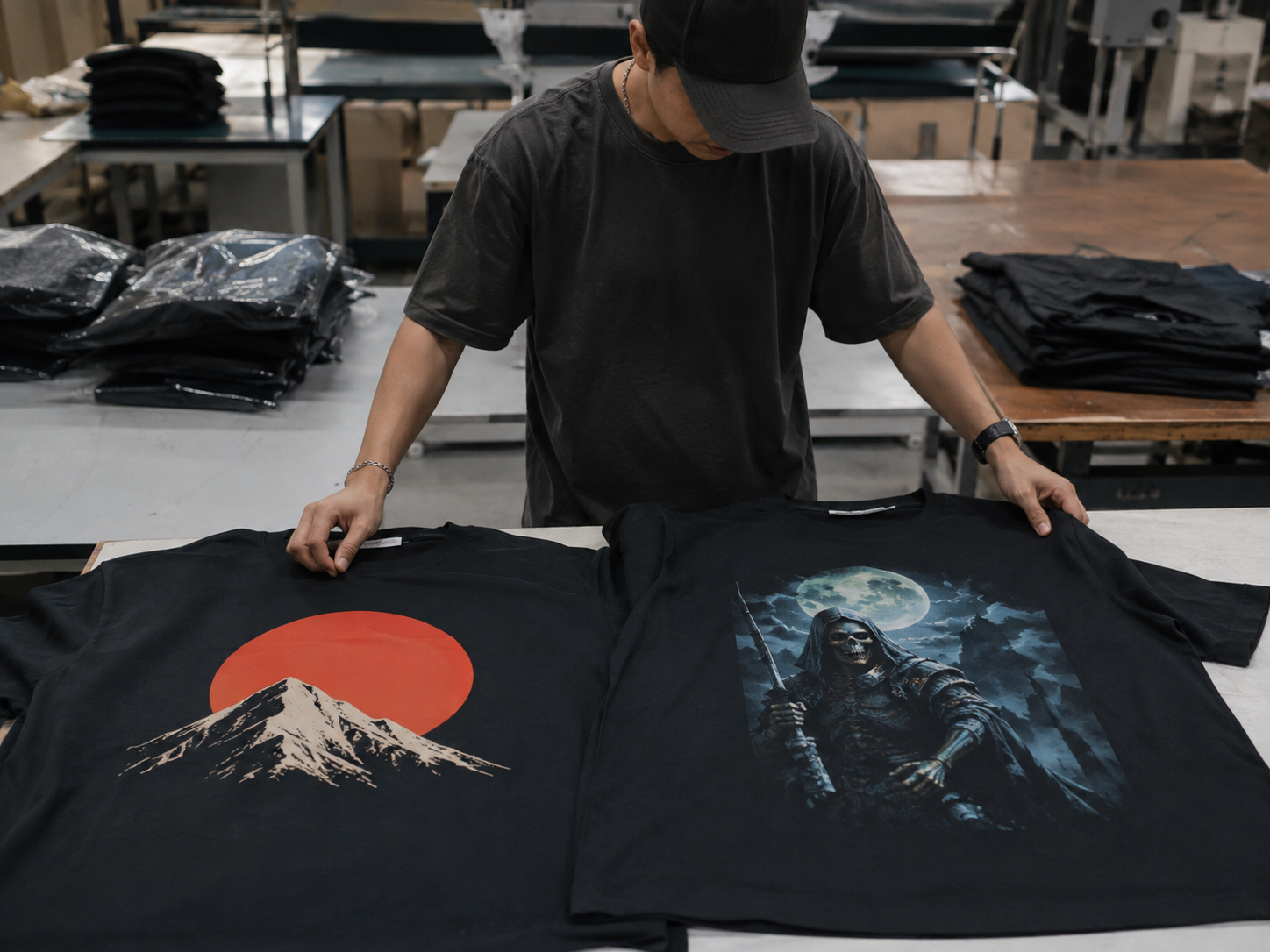
This table is a general comparison.
Actual results depend on the printer, ink, fabric, artwork, and production quantity.
How We Choose the Printing Method Before Production
When deciding between DTG and screen printing for a heavyweight T-shirt, we prefer reviewing:
- Final artwork
- Final fabric
- GSM
- Fabric surface
- Color
- Quantity
- Number of print locations
- Desired texture
A typical process is:
Artwork Review
↓
Fabric Review
↓
Order Quantity
↓
Choose Screen Print or DTG
↓
Prepare Test
↓
Print Sample
↓
Check Color & Detail
↓
Cure
↓
Wash Test
↓
Approve
↓
Bulk Production
For heavyweight streetwear, the garment should be tested using the actual production fabric.
Changing from:
220 GSM smooth cotton
to:
300 GSM rough cotton
can change the print result even if the artwork stays exactly the same.
Frequently Asked Questions
Is screen printing better than DTG for heavyweight T-shirts?
Not always.
Screen printing is very effective for bold graphics and bulk production, while DTG can be better for detailed, multi-color artwork.
Can DTG print on 300 GSM T-shirts?
Yes.
The more important factor is often the fabric surface, cotton content, and pretreatment compatibility rather than GSM alone.
Is DTG good for black T-shirts?
Yes, but dark garments usually require pretreatment and a white ink base.
The process needs to be controlled carefully.
Which print is better for oversized streetwear?
Both can work.
Screen printing is popular for bold streetwear graphics, while DTG works well for complex full-color designs.
Which method is cheaper?
It depends on quantity and artwork.
DTG may be practical for small quantities, while screen printing often becomes more efficient for larger repeated orders.
Is screen printing more durable?
A properly produced screen print can be very durable.
A properly produced DTG print can also perform well.
Curing, pretreatment, fabric, and washing conditions all affect durability.
Can DTG produce puff print?
Standard DTG does not create the same raised puff effect as traditional puff screen printing.
For strong dimensional effects, screen printing is generally the more suitable technique.
Which is better for photographic graphics?
DTG is often a strong option because it can reproduce gradients and many color transitions without traditional multi-screen separation.
Final Recommendation
For heavyweight streetwear T-shirts, do not choose the printing method based only on GSM.
Choose Screen Printing when you want:
Bold Colors + Large Graphics + Specialty Effects + Efficient Bulk Production
Choose DTG when you want:
Photographic Detail + Gradients + Many Colors + Smaller Quantities
The most important factors are:
Artwork + Fabric Surface + Quantity + Color + Desired Hand Feel
For a 260 GSM oversized streetwear T-shirt, either technique can work extremely well when developed correctly.
The safest workflow is:
Final Fabric → Final Artwork → Print Test → Cure → Wash Test → Approve
If you are developing heavyweight graphic T-shirts, oversized streetwear, screen prints, puff prints, or DTG designs, Fuki Apparel can help with fabric selection, print testing, sampling, and bulk production.