
When developing a custom streetwear collection, one of the earliest sourcing decisions is:
Should you use stock fabric or custom-dyed fabric?
At first, the difference seems simple.
Stock fabric is already available.
Custom-dyed fabric is produced in your requested color.
But this decision can affect much more than color.
It can influence:
- MOQ
- Sampling speed
- Production lead time
- Color control
- Repeat orders
- Fabric availability
- Final garment cost
From our experience producing custom streetwear, neither option is always better.
For a startup testing its first collection, stock fabric may reduce risk and speed up development.
For an established brand that needs a specific signature color across larger orders, custom dyeing may provide better control.
The right choice depends on:
Order Quantity + Color Requirement + Timeline + Budget + Repeat-Order Plan
Table of Contents
- What Is Stock Fabric?
- What Is Custom-Dyed Fabric?
- 1. Stock Fabric Is Usually Faster
- 2. Stock Fabric Can Reduce MOQ Pressure
- 3. Custom Dyeing Gives You More Color Control
- 4. Custom Color Still Requires Lab Dip Approval
- 5. Stock Fabric Availability Can Change
- 6. Custom Dyeing Makes Repeat Orders Easier to Standardize
- 7. Shade Variation Can Happen With Both Options
- 8. Cost Is More Than Just Fabric Price
- Which Option Is Better for Different Clothing Brands?
- How We Choose Between Stock and Custom-Dyed Fabric
- Frequently Asked Questions
- Final Recommendation
What Is Stock Fabric?
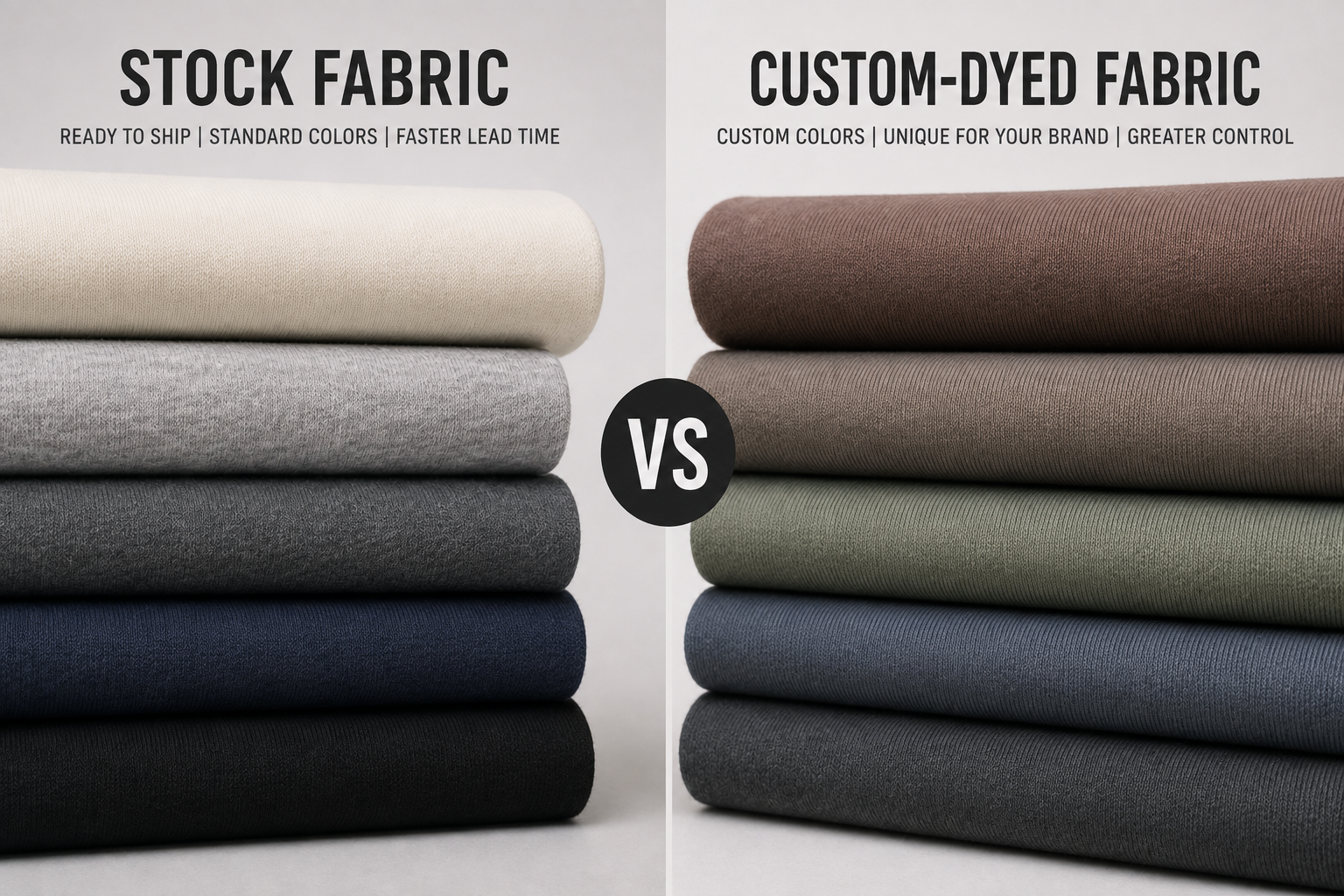
Stock fabric is material that a fabric supplier or mill already has available.
The fabric may already be:
- Knitted
- Dyed
- Finished
- Packed
- Ready for shipment
For example, a supplier may keep standard colors such as:
- Black
- White
- Heather gray
- Navy
- Cream
- Brown
in regular production.
If the fabric specification and available color work for your design, the factory can often source it without waiting for a new dyeing production run.
Stock fabric is particularly useful for:
- Sampling
- Small collections
- Startup brands
- Fast launches
- Basic colorways
However, "in stock" should always be confirmed against the actual quantity required for bulk production.
A supplier having enough fabric for one sample does not necessarily mean they have enough for 500 garments.
For more information about fabric sourcing:
How to Source Streetwear Fabrics
What Is Custom-Dyed Fabric?
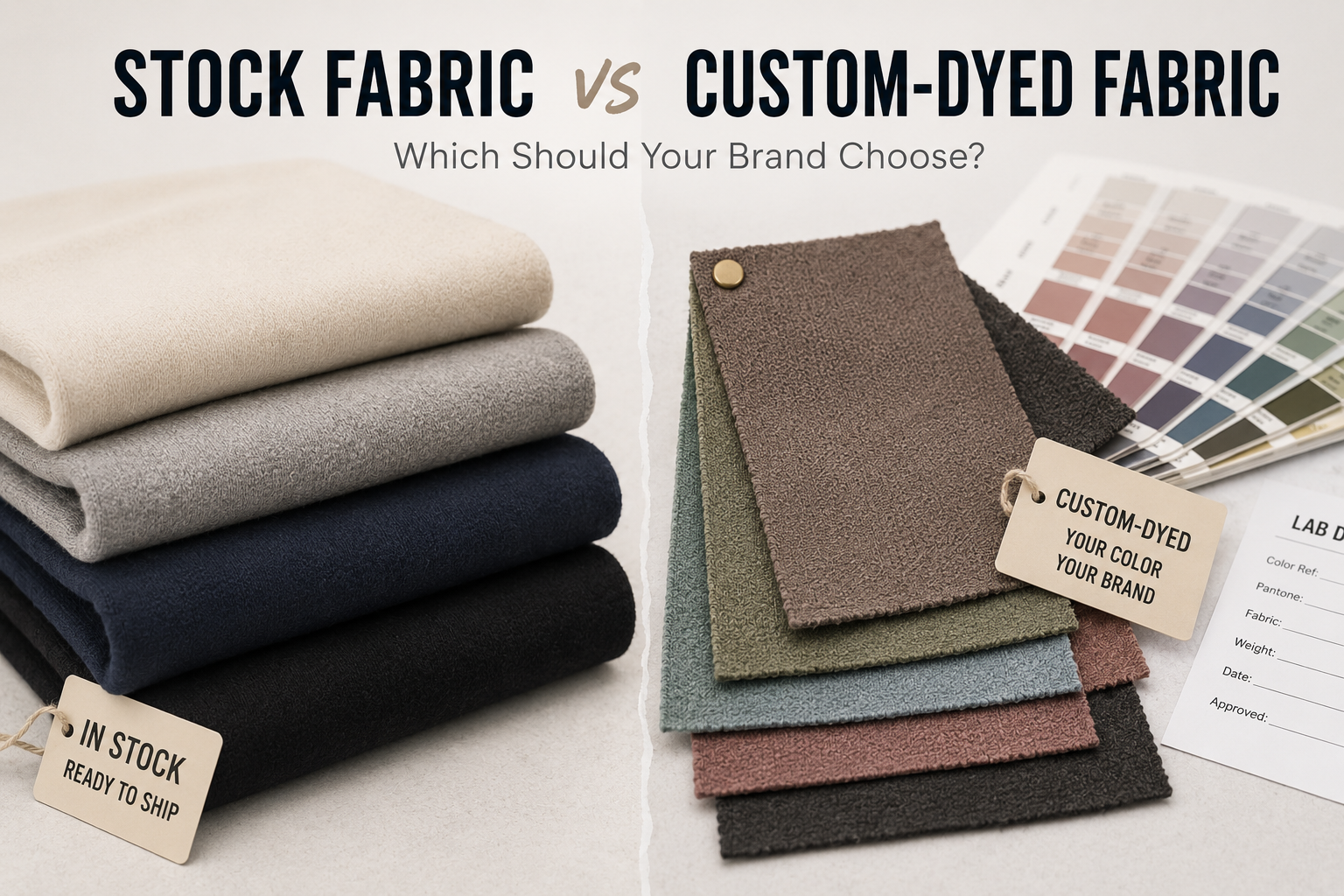
Custom-dyed fabric is produced or dyed specifically to match a requested color standard.
The process may look like:
Select Fabric Construction
↓
Provide Color Reference
↓
Create Lab Dip
↓
Review Color
↓
Adjust if Required
↓
Approve Lab Dip
↓
Bulk Dyeing
↓
Fabric Finishing
↓
Bulk Fabric Inspection
A brand may provide:
- Pantone reference
- Physical fabric swatch
- Existing garment
- Approved color standard
The fabric mill then develops a dye recipe intended to match that target as closely as reasonably possible on the selected material.
Custom dyeing is commonly used when a brand wants:
- Signature colors
- Seasonal color collections
- Better color consistency across an order
- Colors unavailable from stock
1. Stock Fabric Is Usually Faster
The biggest advantage of stock fabric is usually speed.
If the correct fabric is available in sufficient quantity, the production process may move directly from:
Fabric Confirmation → Sampling / Bulk Production
Custom dyeing adds several additional steps.
For example:
Color Development
↓
Lab Dip
↓
Approval
↓
Bulk Dyeing
↓
Finishing
↓
Inspection
Depending on the fabric mill, quantity, fiber composition, season, and finishing requirements, this can add meaningful time to the production schedule.
For brands working toward a fixed launch date, stock fabric can therefore reduce sourcing risk.
However, the factory should still confirm:
- Actual stock quantity
- Fabric batch
- Width
- GSM
- Composition
- Finishing
before relying on the material for bulk production.
2. Stock Fabric Can Reduce MOQ Pressure
Custom dyeing normally requires a minimum production quantity.
Why?
A dye house has setup requirements for:
- Dye machine loading
- Dye chemicals
- Water
- Energy
- Labor
- Finishing
Running a very small quantity can be inefficient or disproportionately expensive.
Stock fabric can sometimes allow brands to purchase smaller quantities because the supplier already produced the larger dye lot.
This can be useful for:
Startup Brands
A new brand may not want hundreds of pieces in one color.
Market Testing
You may want to test several colors before committing to larger orders.
Sampling
Only a few meters may be required for development.
However, stock fabric does not automatically mean "no MOQ."
The fabric supplier and garment factory may still have minimum purchasing or production requirements.
3. Custom Dyeing Gives You More Color Control
This is the main reason brands choose custom-dyed fabric.
Imagine your collection requires a specific muted brown.
The stock supplier offers:
- Dark brown
- Chocolate
- Taupe
but none match the brand's visual direction.
Custom dyeing allows the mill to develop a color based on your approved reference.
This is particularly important for brands building recognizable color identities.
Custom dyeing can also help when multiple products need to use a similar color direction.
For example:
Hoodie + Sweatpants + T-Shirt
However, the fabrics should still be reviewed individually.
A color can appear different on:
- Heavy fleece
- Jersey
- Rib
- French Terry
even when they are targeting the same color standard.
This happens because fiber composition, knit structure, surface texture, and finishing influence how color appears.
4. Custom Color Still Requires Lab Dip Approval
A Pantone number should not be treated as an automatic guarantee of the final textile color.
Before bulk dyeing, fabric mills normally prepare a lab dip.
A lab dip is a small dyed fabric sample used to evaluate the proposed color.
The brand can then review whether the result is:
- Too dark
- Too light
- Too warm
- Too cool
- Too red
- Too blue
If necessary, the dye recipe can be adjusted before bulk production.
A typical process may involve:
Lab Dip A
Lab Dip B
Lab Dip C
with slightly different color directions.
Once one option is approved, the supplier uses it as the production target.
Pantone provides textile color systems widely used to communicate color standards in apparel development.
External reference:
Pantone Fashion, Home + Interiors
The important point is:
Pantone Reference → Color Target
not:
Pantone Reference = Guaranteed Identical Appearance on Every Fabric
Physical approval is still important.
5. Stock Fabric Availability Can Change
One of the biggest risks with stock fabric is availability.
A fabric may be available when the sample is made.
Several weeks later, when the brand places a bulk order, the supplier may say:
"This batch has sold out."
This creates several possible problems.
The factory may need to:
- Wait for a new batch
- Find an alternative fabric
- Custom produce the fabric
- Change the color
- Remake a sample
This is why sample availability and bulk availability should be treated separately.
Before approving a stock fabric for production, we prefer confirming:
How much fabric is currently available?
and:
Is this quantity enough for the planned order plus reasonable production allowance?
For time-sensitive collections, this confirmation is very important.
6. Custom Dyeing Makes Repeat Orders Easier to Standardize
For brands planning repeat orders, custom dyeing can provide a clearer color standard.
The brand can retain:
- Approved lab dip
- Approved bulk fabric
- Dye recipe reference
- Physical garment sample
When the next order is produced, the mill has a defined standard to work toward.
This does not mean repeat batches will be visually identical without checking.
Textile dyeing naturally has production variables.
But a documented color standard gives the supplier a much better reference than simply saying:
"Use the same brown as last time."
For important repeat colors, the new bulk fabric should still be compared against the approved original standard before cutting.
7. Shade Variation Can Happen With Both Options
Color variation is not only a custom-dye problem.
Stock fabric can also come from different dye lots.
For example:
Stock Batch A
may look slightly deeper than:
Stock Batch B
If both batches are used in one production order, the difference may become visible after garments are assembled.
Custom-dyed fabric can also show variation if:
- Different dye lots are produced
- Fiber batches change
- Finishing conditions change
- Washing changes the surface
This is why large orders should avoid mixing different fabric lots unnecessarily.
For bulk production, we normally want the garment pieces used in one style and colorway to come from a controlled fabric lot whenever possible.
8. Cost Is More Than Just Fabric Price
When brands compare stock and custom-dyed fabric, they often look only at:
Price Per Meter / Kilogram
But the real project cost also includes:
- MOQ
- Sampling
- Lab dips
- Development time
- Shipping
- Inventory risk
- Production delay risk
For example:
A custom-dyed fabric may have an attractive unit price at a larger quantity.
But if the brand only needs a small order, the fabric MOQ may create excess material.
Stock fabric may cost slightly more per unit but reduce unused inventory.
The opposite can also happen.
For larger repeat orders, custom production may become more economical and provide better control.
The best decision should therefore consider:
Total Project Cost
rather than only:
Fabric Unit Price
Which Option Is Better for Different Clothing Brands?
There is no single correct answer.
Choose Stock Fabric If You Want:
- Faster development
- Lower initial risk
- Smaller test orders
- Standard colors
- Quick sampling
Stock fabric is often suitable for:
- New brands
- First collections
- Market testing
- Basic black / white products
Choose Custom-Dyed Fabric If You Want:
- Unique brand colors
- Seasonal color development
- Better color control
- Larger orders
- Repeatable color standards
Custom dyeing is often better for:
- Established collections
- Signature brand colors
- Larger production programs
- Repeat orders
For some brands, the best solution is actually to use both.
For example:
Core Black / White
→ Stock Fabric
Seasonal Brand Colors
→ Custom Dyeing
This can balance speed, cost, and differentiation.
How We Choose Between Stock and Custom-Dyed Fabric
For a custom streetwear project, we normally start by understanding:
- Order quantity
- Target GSM
- Fabric composition
- Color requirements
- Launch date
- Future reorder plans
Then the sourcing process may look like:
Confirm Fabric Specification
↓
Search Stock Options
↓
Compare Color & Hand Feel
↓
Check Bulk Availability
↓
Decide Stock or Custom Dye
↓
Lab Dip if Required
↓
Sample Development
↓
Bulk Fabric Approval
↓
Cutting
During bulk fabric inspection, we may review:
- Color
- GSM
- Width
- Hand feel
- Surface
- Shade consistency
- Shrinkage
The safest decision is usually made by evaluating the complete production plan, not simply choosing the quickest fabric.
Frequently Asked Questions
Is stock fabric lower quality than custom-dyed fabric?
No.
Stock only describes availability.
A high-quality mill can keep premium fabrics in stock, while custom dyeing simply provides more control over color.
Is stock fabric better for startup clothing brands?
Often yes.
Stock fabric can reduce lead time, color-development work, and inventory commitment.
Can stock fabric sell out after sampling?
Yes.
This is why bulk availability should be reconfirmed before the order moves into production.
Does custom dyeing guarantee an exact Pantone color?
No.
Pantone provides a target reference, but the final appearance depends on fiber, fabric construction, dye system, and finishing.
A physical lab dip should be approved.
Does custom-dyed fabric have a higher MOQ?
Usually it does because the mill or dye house needs a minimum efficient production quantity.
The actual MOQ depends on the supplier and material.
Can two custom-dyed batches look slightly different?
Yes.
Dye lot variation can occur, which is why new bulk fabric should be checked against the approved standard.
Which option is faster?
Stock fabric is usually faster when the required fabric and quantity are already available.
Which option is better for repeat orders?
Custom-dyed fabric can provide a clearer controlled color standard for repeat production, especially for signature brand colors.
Final Recommendation
Stock fabric and custom-dyed fabric solve different problems.
Choose stock fabric when your priority is:
Speed + Flexibility + Lower Initial Commitment
Choose custom-dyed fabric when your priority is:
Color Control + Brand Identity + Repeat Production
For many new brands, using stock fabric for the first collection can reduce development risk.
Once order quantities become larger and the brand develops signature colors, custom dyeing may become more useful.
The safest workflow is:
Confirm Fabric → Check Stock → Review Quantity → Develop Lab Dip if Needed → Make Sample → Approve Bulk Fabric → Cut
If you are developing oversized T-shirts, hoodies, sweatshirts, or other custom streetwear, Fuki Apparel can help with stock fabric sourcing, custom color development, lab dips, sampling, bulk fabric inspection, and production.