
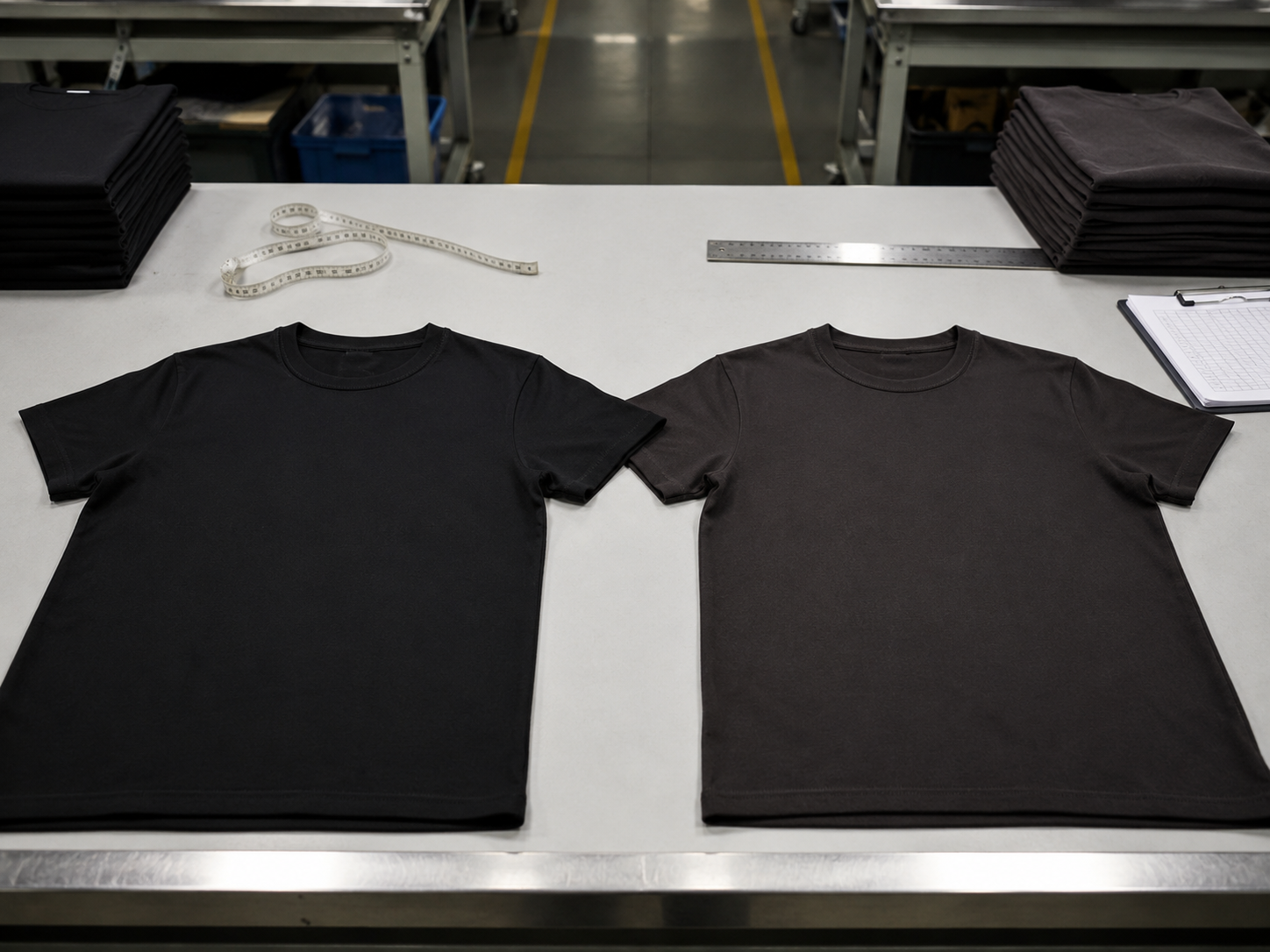
You put two black T-shirts next to each other under the same factory light.
One looks deep black.
The other looks slightly gray, brown, blue, or washed out.
But both fabrics were ordered as "black."
Why?
Because black is not one single color.
The final appearance of black fabric depends on the fiber, dye recipe, fabric structure, surface texture, finishing process, washing, and the way the material reflects light.
From our experience sourcing fabrics for custom streetwear, two fabrics can use similar black color standards and still look noticeably different when placed side by side.
That is why black fabric should always be approved using the actual material, not only a Pantone number or a digital photo.
Table of Contents
- Why Black Fabric Is Difficult to Match
- 1. Different Fibers Produce Different Blacks
- 2. Different Dye Recipes Can Create Warm or Cool Black
- 3. Fabric Texture Changes How Black Reflects Light
- 4. Knit Structure Can Change the Depth of Black
- 5. Washing and Finishing Can Make Black Look Lighter
- 6. Surface Gloss Can Make One Black Look Deeper
- 7. Lighting Can Reveal Differences Between Two Blacks
- How We Compare Black Fabrics Before Bulk Production
- How Should Brands Approve Black Fabric?
- Frequently Asked Questions
- Final Recommendation
Why Black Fabric Is Difficult to Match
Black seems simple.
In textile production, it is not.
A fabric appears black because it absorbs a large amount of visible light and reflects relatively little back to our eyes.
But different fibers, dyes, finishes, and surfaces do not absorb and reflect light in exactly the same way.
That means two fabrics can both be described as:
Black
while one appears:
Deeper / Cleaner / Cooler
and the other appears:
Softer / Warmer / Grayer
This becomes especially noticeable when the fabrics are placed directly next to each other.
For streetwear brands, this matters when one garment combines several materials such as:
- Main body fabric
- Rib
- Hood lining
- Drawcord
- Pocket fabric
- Embroidery thread
- Woven labels
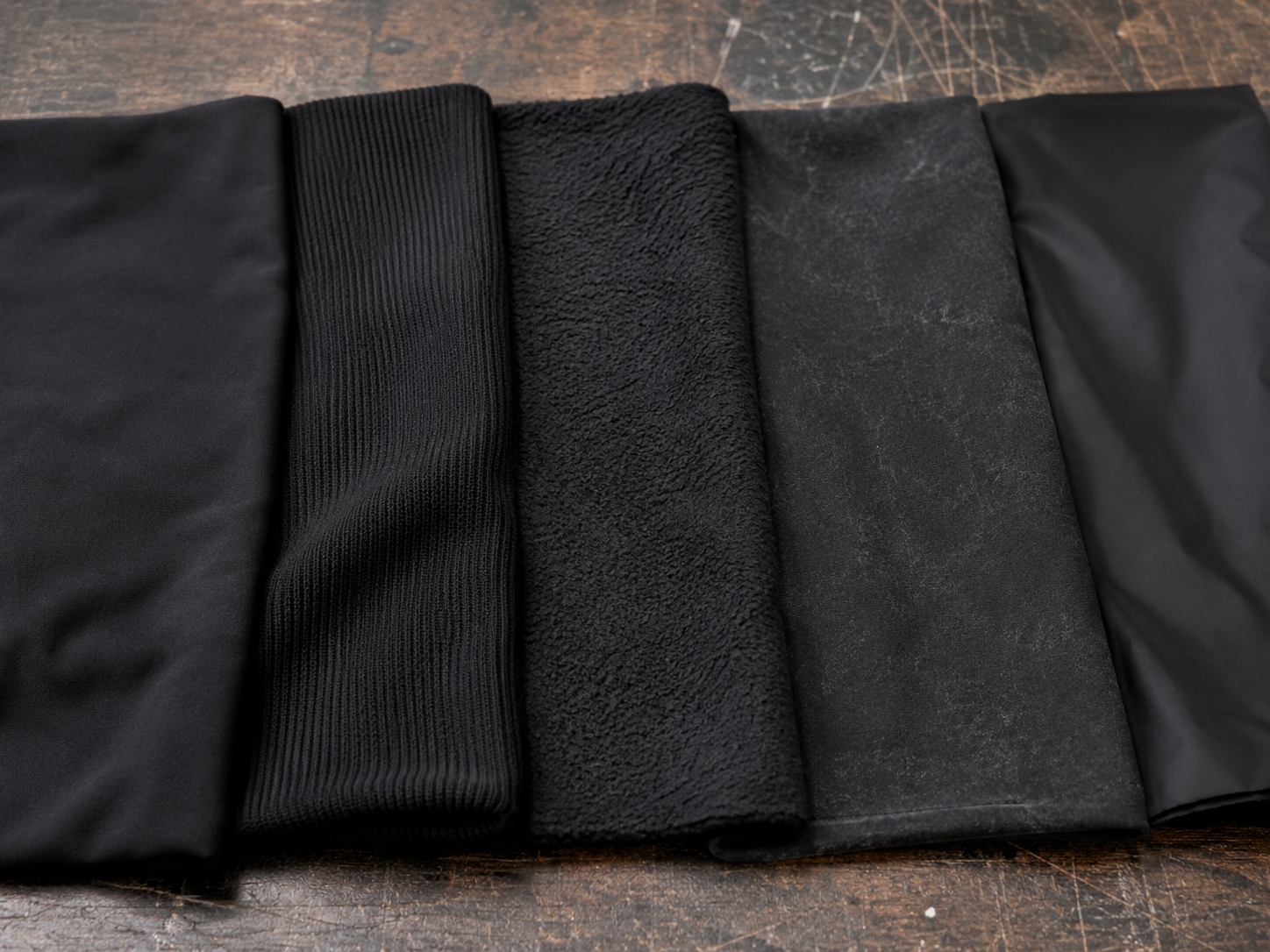
If these materials are supposed to be the same black, they should be checked together.
If you are still selecting materials, read:
How to Source Streetwear Fabrics
1. Different Fibers Produce Different Blacks
The first thing we check is fiber composition.
For example:
100% Cotton
and
100% Polyester
do not use the same dye system.
Cotton is normally dyed with dyes suitable for cellulose fibers, while polyester requires dyes designed for synthetic fibers.
Because the chemistry is different, the final black may also be different.
Even if both fabrics are targeting a similar visual black, one may appear:
- Slightly blue
- Slightly red
- Slightly brown
- More neutral
- More saturated
This is especially important for garments that combine different materials.
For example, a hoodie might use:
Cotton Fleece Body + Cotton/Spandex Rib + Polyester Drawcord
All three components may be ordered in black.
That does not automatically mean they will look identical.
This is why the complete garment should be reviewed, not only each material separately.
2. Different Dye Recipes Can Create Warm or Cool Black
Black textile color is often created through a combination of dyes rather than one universal "black" formula.
Different dye combinations can produce different undertones.
For example, one black fabric may have a subtle:
Blue undertone
while another has a:
Red or brown undertone
Individually, both may look black.
Place them next to each other and the difference becomes much easier to see.
This is one reason a customer may say:
"This black looks too warm."
or:
"This fabric looks more blue-black than the approved sample."
The issue may not be that the fabric is obviously the wrong color.
The undertone is different.
For brands trying to maintain the same black across several products, the safest method is to keep an approved physical fabric swatch as the reference.
3. Fabric Texture Changes How Black Reflects Light
Color is not the only factor.
Surface texture also changes appearance.
Compare a smooth cotton jersey with a rough garment-washed fabric.
The smooth surface reflects light more evenly.
The washed surface contains:
- Raised fibers
- Irregular texture
- Small shadows
- Faded high points
This can make the second fabric appear softer or lighter even when the actual dye color is similar.
X-Rite explains that visual appearance is affected by more than color alone. Surface characteristics such as texture, gloss, and viewing conditions can change how we perceive an object's color.
External reference:
X-Rite – Controlling Color and Appearance
This is particularly important for streetwear fabrics such as:
- Vintage washed cotton
- Pigment-dyed jersey
- Acid-washed fabric
- Brushed fleece
- Slub cotton
- Heavyweight jersey
A heavily washed black T-shirt should not be expected to look exactly like a smooth solid-black cotton T-shirt.
They are designed to have different appearances.
4. Knit Structure Can Change the Depth of Black
Two fabrics can have the same fiber content and similar dye recipe but different knitting structures.
For example:
Single Jersey
French Terry
Fleece
Rib
These fabrics have different surfaces.
The yarns are positioned differently.
Some structures create more shadow between loops, while others expose more fiber to the light.
This changes the visual depth of the fabric.
A dense heavyweight jersey may appear deeper and more solid than a lighter, more open knit.
A rib can also look slightly different from the body fabric because its raised structure reflects light from different angles.
This is why we do not recommend choosing rib only by saying:
"Just match the body fabric black."
Instead, the rib should be physically compared with the actual body fabric.
For more information about common streetwear materials, see:
Best Streetwear Fabrics for 2026
5. Washing and Finishing Can Make Black Look Lighter
Streetwear often uses black fabric specifically because it can develop attractive washed effects.
Processes such as:
- Pigment wash
- Vintage wash
- Enzyme wash
- Acid wash
- Mineral wash
- Garment dye
- Stone wash
can change the surface of the fabric.
After washing, black may become:
- Charcoal
- Faded black
- Gray-black
- Vintage black
- Uneven black
This is often intentional.
The wash removes or changes some of the color at the fabric surface and creates a more worn-in appearance.
The important point is that:
Solid Black ≠ Washed Black
Even if both started from a similar dark color.
A washed fabric should therefore be approved against a washed reference sample, not against an unwashed black fabric.
6. Surface Gloss Can Make One Black Look Deeper
Another reason two black fabrics look different is gloss.
A smoother or more lustrous surface reflects light differently from a matte fabric.
For example:
Smooth synthetic fabric
may appear cleaner or more reflective.
While:
Brushed cotton fleece
may appear softer and more matte.
Even under exactly the same lighting, their appearance can be noticeably different.
This does not necessarily mean one fabric was dyed incorrectly.
The surfaces are simply interacting with the light differently.
This becomes particularly obvious when combining materials such as:
- Cotton and nylon
- Cotton and polyester
- Matte jersey and shiny mesh
- Main fabric and rib
- Fleece and woven panels
If a design uses mixed materials, brands should decide whether they want:
Exact visual matching
or
Intentional tonal contrast
before bulk production.
7. Lighting Can Reveal Differences Between Two Blacks
Even though two black fabrics already look slightly different under the same light, changing the light source can sometimes make the difference even stronger.
This is related to a color phenomenon called metamerism.
Metamerism occurs when two materials appear to match under one lighting condition but look different under another because their spectral reflectance is different.
Datacolor describes metamerism as two objects appearing to match under one light source but separating visually under another.
External reference:
Datacolor – What Is Metamerism?
For example:
Two black fabrics may look very similar under factory fluorescent lighting.
Then you take them outside into daylight.
One looks neutral black.
The other suddenly looks slightly brown.
This is why professional textile color evaluation often uses controlled lighting conditions.
Datacolor also recommends evaluating materials under multiple standardized light sources when color consistency is important.
External reference:
Datacolor – How to Use a Light Booth for Accurate Color Evaluation
For streetwear brands, this matters because the final garment will be seen under:
- Daylight
- Retail lighting
- Studio lighting
- LED lighting
- Indoor home lighting
not only under factory lights.
How We Compare Black Fabrics Before Bulk Production
When a garment uses several black materials, we prefer evaluating them together before bulk production.
A typical process is:
Approved Black Standard
↓
Fabric Swatches
↓
Body Fabric + Rib + Trims Comparison
↓
Check Under Controlled Light
↓
Check Under Daylight
↓
Sample Garment
↓
Final Approval
↓
Bulk Production
During this process, we normally check:
- Black depth
- Undertone
- Fabric texture
- Surface gloss
- Body-to-rib matching
- Wash effect
- Trim matching
- Batch consistency
The most important thing is to evaluate the materials side by side.
A black fabric viewed by itself may look completely acceptable.
The difference often becomes obvious only after it is placed next to the approved reference.
How Should Brands Approve Black Fabric?
For important black products, we recommend using a physical approval process.
1. Keep a Physical Black Standard
Do not rely only on a computer image.
Keep the approved swatch or sample.
2. Compare the Actual Production Fabric
The fabric used for sampling and bulk production should be compared with the approved standard.
3. Check Different Components Together
If the garment uses black body fabric, rib, drawcord, zipper, or mesh, review them together.
4. Check the Fabric Under More Than One Light Source
At minimum, compare the material under controlled indoor lighting and natural daylight when color matching is important.
5. Approve Washed Fabric After Washing
Do not judge the final color of a vintage washed garment before the wash process is completed.
6. Check Bulk Fabric Before Cutting
If the bulk fabric looks significantly different from the approved sample, it is much easier to solve before hundreds of garments have already been cut.
That is why our preferred sourcing process is:
Fabric Approval → Sample → Bulk Fabric Approval → Cutting
rather than approving fabric only once at the beginning of development.
Frequently Asked Questions
Why does one black T-shirt look gray next to another black T-shirt?
The fabrics may have different dye depth, undertones, surface textures, or finishes.
A washed or textured black fabric can also reflect more light and appear lighter.
Can cotton and polyester have exactly the same black?
They can be matched closely, but they use different dye systems and have different surfaces.
A physical comparison is recommended when exact matching is important.
Why does black rib look different from the black body fabric?
Rib and body fabric have different knit structures and may also contain different fiber compositions.
These differences can change how the materials absorb dye and reflect light.
Why does washed black look lighter?
Washing and finishing processes intentionally change the surface color and texture.
Vintage or pigment washed black often develops a softer charcoal appearance.
What is blue-black?
Blue-black is a black with a subtle cool or blue undertone.
Other black fabrics may have red, brown, or neutral undertones.
Can two black fabrics match indoors but look different outside?
Yes.
This can be caused by metamerism, where different materials respond differently when the light source changes.
Should I approve black fabric from photos?
Photos are useful for communication, but they are not the safest standard for critical color approval.
Camera settings, screens, and lighting can all change how black appears.
A physical swatch is more reliable.
Final Recommendation
If two black fabrics look different under the same light, do not assume that one is automatically defective.
Check the complete material system:
Fiber Content + Dye Recipe + Undertone + Knit Structure + Surface Texture + Finish + Washing + Light Reflection
For streetwear production, black should be treated like any other controlled color.
The safest workflow is:
Approve Physical Swatch → Compare Actual Fabrics → Check Components Together → Review Under Multiple Lights → Approve Sample → Check Bulk Fabric → Cut
This is especially important when one garment combines several black materials.
From our experience, most black color disputes are much easier to solve during fabric approval than after bulk garments are completed.
If you are developing black T-shirts, hoodies, washed streetwear, or garments combining multiple fabrics, Fuki Apparel can help with fabric sourcing, color matching, sample development, garment washing, and bulk production.